Friday, 22 November 2013

Apologists for genocide

Primo Levi, a Holocaust survivor and testimonial writer, found it urgent to raise awareness of the horrors he had witnessed. It pained him to hear of holocaust revisionists and deniers. If we forget about the lessons of history, the unthinkable can happen again. If we forget about tyrants such as Hitler and Stalin, if we start with a tabula rasa, their crimes will be repeated.

Our times are particularly perilous in that we are undergoing socio-economic circumstances similar to the 1920s. Whilst Western Europe will not have a repeat of these horrors - the lessons of the Holocaust are deeply entrenched - Eastern Europe is taking a scary turn in that direction. With high unemployment, extreme ideologies seem to people to be the ideal solvent to their ills. The third biggest political party in Hungary stated that all the Jews in Hungary must be counted. The Golden Dawn in Greece is also terrorising racial minorities and capturing the imagination of younger voters.

In a recent documentary about the Indonesian genocide of 1965, The Act of Killing, we see the perpetrators several years hence. 500,000 people were killed within three days. The Western media portrayed the killings as a decisive victory over communism during the cold war. The gang members who carried out the crimes now live with equanimity. When asked about their crimes, they seem vindictive. In one startling scene, when asked if the communists might want revenge, one member replies along the lines of 'Well, we will just crush their skulls and they will be quiet.' The whole room lights up, the chat show host smirks and everyone claps with fervor.


The Act of Killing

What is interesting about this scene - and representative of these apologists - is that communists are not vilified for their political beliefs. They are vilified for being 'the other,' 'the parasite,' 'the enemy.' The annihilation of this tribe or ethnic group guarantees the realisation of a political agenda. In the case of Nazi Germany, the annihilation of the Jews would create an 'Aryan' society and a Superman. In the case of Indonesia and Chile, the annihilation of the 'communists' would segue way into a free market capitalist society.

In the case of Chile, thousands of people were detained, tortured and killed. Of course, the right have ceaselessly tried to justify their actions. They even fabricated a story, which was believed for decades, called 'Plan Z.' The right claimed that Allende planned self-coup to impose a marxist government. Such a plan never existed. This was a psychological game forged by the military to justify their crimes against humanity.


Chile, September 11 1973

What often happens is that the oppressors continue to prosper and the oppressed continue to suffer. In Chile, to be a 'Pinochetista' is completely uncontroversial. I know several people who have no qualms with being so. But, of course, if you support a cause, you support all the killings, tortures and crimes that cause entails. In effect, you are an apologist for genocide. These people are completely unrepentant and lead comfortable lives.

The trial of Pinochet was interesting in that it was the first time a war criminal had been brought to trial by an international jury. Why should it solely be an internal affair? If international law were curtailed, it would set a precedent and many more criminals would be trialed.

I have seen many comments stating 'Both Allende and Pinochet are a disgrace - let's forget about it and move on.' First of all, that is deeply disrepectful to the victims. Secondly - I'll drill in this point for the umpteenth time - history rarely repeats itself. This is because genocides are remembered. Germany is now a pluralist society, deeply mindful about its attitude. However grotesque the past may be, it must be remembered. The apologists who skew it must be brought to account.

Sunday, 10 November 2013

What is 'Cosmopolitan Literature'?

'Cosmopolitan Literature' is, I hope, my own coinage. I will explain what I mean by it later on. First of all, I will make a couple of distinctions.

'World Literature' is a marketing term used to denote foreign writers. These are rigid categories and foreign writers are mutually exclusive from local ones. It is largely a promotional term for writers overseas. Coined by Goethe in the 18th century, it is pretty much an out-dated term used at a time when countries were beginning to unify and when nationalism was rife. The term 'world' is problematic since it casts foreign writers as somehow 'other.' Anglophone writers are beyond categorisation, which seems absurd. A very Euro-centric category which has overtones of imperialism.

'Comparative Literature' is an academic discipline used to analyse linguistic differences between writers from different countries, in addition to the usual critical perspectives from an English course. A useful discipline which not only broadens out from national barries but also draws from several other disciplines not commonly associated with literature. 

So what is 'Cosmopolitan Literature' and how does it differ from the aforementioned categories. Cosmopolitan Literature holds that national borders are superflous and that there is a universal consciousness we all experience. This consciousness should be portrayed in literature, instead of relying on a parochial attitude of just representing the cultural mores of one's local society. It holds that literary styles developed from certain cultures can be freely adapted from others. A truly successful 'cosmopolitan' writer is one whom you cannot tie to a specific national canon. 

Who eludes this category? Since when is Jorge Luis Borges Argentinean, for instance? The pampas appear in several stories, but his writing is more European than anything else. Although Conrad is called English because he wrote in the language, he wrote a novel set in Russia and novels like Nostromo are set abroad and populated by people from different nationalities. Is Roberto Bolano Chilean or Mexican or Spanish? The stamp of a true cosmopolitan writer is that he defies being placed in a cultural pigeonhole. This is because he avoids the style characterised by his local school and because he engages with different cultures.

Thursday, 31 October 2013

The tactical fundamentalist

Marcelo Bielsa

Although I am not a very acute observer of football, when a passing side plays well I find it very aesthetically pleasing. I like to watch teams which are attacking and positive. And they do not get any more attacking and positive than Marcelo Bielsa.

When a Bielsa side plays at maximum capacity, it puts teams like Barcelona and Spain to shame. I sometimes find myself yawning when I watch that type of tiki-taka football. Bielsa's teams are well-drilled and pass the ball well, but it is ratcheted up to 500 miles per hour. Every single player presses the opposition and aims to retrieve the ball. His sides play with three defenders and even their role is offensive. The objective is to score more goals than the opposition, regardless of who the opponent is. Bielsa has his own philosophy and it will never be revised. You might call it inflexible and predictable, but for football purists it is a manna from heaven. Even if you call it reckless, you can't argue that it also gets results.

His eccentricities only make him more endearing. With a pair of gold-rimmed glasses dangling from the holders, he resembles a crochety professor or your favourite uncle. He crouches on the manager's dug-out, intently peering out onto the pitch. He trudges through the dug-out, endlessly analysing the ways he can win the game. Indeed, he is such an astute tactician that he can change the course of the match through a couple of substitutions.

Bielsa is from a football-mad town in Argentina called Rosario. The two teams are either Rosario Central and Newell's Old Boys. His father was a Rosario Central and Bielsa, being a contrarian, decided to ardently support Newell's.

His obsessive nature already flowered in early childhood. During one of several military dictatorships in Argentina, the police ordered a group of kids to stop playing a obstructive game of football in the street. They took his ball away. Bielsa stated that if the ball went, he went. He was arrested and his ball eventually returned, because he simply would not stop carping on about it. As we shall see, Bielsa is a very principled man.

After a brief playing career in Newell's, he took over the club as manager and led them to a championship trophy. He even took them to the final of the Copa Libertadores (the equivalent of the Champion's League). He has since acquired a legendary status at the club; one of the stadium's stands is named after him. Only a couple of years ago, the fans were being called upon to vote for a new president and Bielsa flew in and was the first person in the cue to vote.

His career is tainted by one regrettable episode, as Argentina manager the 2002 world cup. It is clear that he 'over did' the preparations. He assiduously overtrained the squad and they literally could only limp onto the pitch. Argentina crashed out in the first round after heading into the tournament as hot favourites.

He remains a divisive figure in Argentina to this day, though he acquired a God-like status in Chile after taking over the reins of the national team. It was footballing renaissance. He also instilled a type of high-pressing game that has now become emblematic of all Chilean football. When he was their manager, he even lived in a little hut in the stadium's ground. Of course, he was accompanied by his encyclopedic library of football videos, which he methodically analyses.

A socialist in his politics, Bielsa only communicates to the media through press conferences. He insists on answering every single question from every media outlet. His answers tend to be long-winded and this means that the conferences drag on for several hours. Indeed, he has stated that 'Every section of the media should get the same attention from me, from the capital's most prominent TV channel to the smallest newspaper in the provinces.'

True to his principles, Bielsa left Chile after some disgusting political manoeuvring. The president, Sebastián Pinera, decided that he simply must go. Bielsa stated that he would leave if his contractor was replaced, Harold-Mayne Nichols. He followed through on this threat when Pinera installed a different candidate.

Later, he moved to the quirky club Athletic Bilbao. As he was now playing European football, I managed to see two of their games.

In the first game, against Real Zaragoza, they managed to win with ten men. The squad had already grasped his methods - they can take a while to sink in - and were climbing up the table. My dad and I even tracked his hotel, but he didn't appear to be inside and it appeared to be a fenced private residence. It could be called stalking, but we were assured that he was receptive to visitors!

The second game was the best football match I have ever been to in my life. It was a Europa Cup tie between Bilbao and Manchester United, in Manchester. Bilbao swept Manchester aside with ease. It was a footballing masterclass. Man Untd. were left very beleaguered.

His methods have also forged a generation of acolytes. Gerardo Martino, the current manager of Barcelona, is an avowed disciple. So is Mauricio Pochetinno, manager of Southampton. And the current manager of Chile, Jorge Sampaoli. All these managers have made their way through Newell's Old Boys youth system. Pepe Guardiola has expressed his admiration, citing him as the best manager alive.

Rigid, obsessive, even brazen, Bielsa makes all of his players believe firmly in his methodology. He is a fundamentalist who never alters his 3-3-1-3 formation. On one occasion the entire Argentinean squad complained that they should play with four defenders instead. Bielsa said, 'Very well, we shall have a vote.' The entire team voted for four defender. 'Ok, then, the team has spoken. We will play with three defenders.'

Saturday, 19 October 2013

Latin-American literature

Before the Second World War, Latin-American writers were scarce even in their homelands. Cheap paperbacks of the latest European novels abounded in book stores. The only local talent that was read widely was Roberto Arlt - his novels were even sold in kiosks. His novels dealt with the seedy side-streets, ruffians, lunatics and mobs of Buenos Aires.

Apart from the odd elite here and there, there was no modernist movement as such. Poets like Vicente Huidobro hastened to Paris and and became fervid presence in Parisian coffee houses. Peruvian poet Cesar Vallejo wrote densely experimental verse, but then he led a tragically isolated life.

Where was there a literature which spoke about nationhood? Where was there a literature which wore its cultural idiosyncrasy on its sleeve? Pablo Neruda wrote the epic Canto General which, among other things, lamented the extinction of indigent tribes. Yet as a whole there was no collective Latin-American 'voice.'

Latin-America has never been a homogeneous culture. Indigenous tribes have interbred with colours and creeds and immigrants have always deluged its shores. Anyone can be a 'Latin-American.' I, for one, having grown up in Chile, consider myself as such. If it ever were to summon up a 'voice,' it would be bound to reflect this cosmopolitanism and diversity.

The European influences of Joyce, Proust, Woolf etc. soon crept in and gelled with the local folklore. Stream of consciousness, unattributed dialogue and multiple perspectives were appropriated by local writers and given a new slant.

Jorge Luis Borges had been writing poetry and prose unassumingly since the 1920s. He was part of the movement 'Ultraism,' which aimed to oppose the prevalence of European modernism and to forge a new voice. Metaphors ought to be kept at a bare minimum, it should be freed of baggy adjectives and still maintain a vestige of ambiguity.

Borges was a very well-read man, deeply familiar with classical literature. He drew from his vast pool of knowledge to form a strange hybrid landscape. He wrote apocryphal reviews and biographies. He wrote about strange creatures. His stories were very prismatic; common motifs included mirrors, parallel worlds, recurring dreams and labyrinths. His deeply surprising stories seemed to take place in a completely different world and lay the groundwork for future writers.

Yet the stories of Borges defied categorisation. You would also be hard-pressed to ascribe him a nationality. Is his fiction Argentinean or is it European?

 
Borges

Later novelists would suffuse this veneer of unreality with local dialect and colloquialisms. Juan Rulfo's Pedro Páramo is an astonishing novel. It appropriates modernist techniques, it is a non-linear narrative which rotates around multiple voices, yet it is written in Mexican dialect. All the characters in the novel are dead and the novel is comprised by their reveries and murmuring voices. It details the decline of an antiquated Mexican rural town and the eponymous characters who wrought its end.

A writer who held a strong influence, but remains obscure to the Anglophone world, was Juan Carlos Onetti. His style has its own beauty and is characterised by its pessimistic somnolent tone. His novels could be called existentialist, but they still have an air of the unreal to them. Most of his novels take place in the mythical 'Santa María,' such as A Brief Life.  A cross between Buenos Aires and Montevideo, it is a mythical land the character Brausen entertains himself with in the form of a screenplay. As he becomes more and more worn down by the reality surrounding him, he eventually immerses himself into this alternate world. Populated by several eccentrics, Santa María would become the setting for most of his later novels. When Uruguay was struck by a coup, Onetti was surprisingly detained. Released after a petition made by several eminent writers, Onetti soberly had Santa María destroyed in Dejemos hablar al viento. (Though it resurfaced as a wasteland in later novels.)


Onneti

All this ultimately culminated in what was termed 'El Boom.' This phenomenon boosted the sales of writers like Rulfo and Onetti. It also popularised Latin-American literature worldwide. The four main exponents were Gabriel García Marques, Mario Vargas Llosa, Julio Córtazar and Carlos Fuentes.

I really can't stand Marquez! His magic realism strikes me as a phony gimmick. I find the writing style monotonous and repetitive. I have tried reading One Hundred Years of Solitude twice and have given up on both occasions. (I also tend to persevere whenever I encounter a cumbersome book!)

Mario Vargas Llosa is a vulpine, versatile writer. He has written about many different periods in Latin-American history and has deft writing style. He has written with panache about tyrants and abuses of power. His writing is very political. Indeed, he run for the Peruvian presidency under the centre-right ticket.

Cortázar is a mixed bag. His stories are brilliant, though I think that his novels have dated horribly. Although Hopscotch has its moments, it is riddled with 1960s cant and follows a group of Bohemians having meandering pseudo-intellectual discussions. His stories have dated far better. They are characterised by their absurdity and deadpan surrealism. Cortázar spoke about 'fissures' - cracks in reality one serependitously chances upon. His best stories rank among my favourites.

Other writers I have not mentioned include Antonio Di Benedetto and José Donoso. The former writes existentialist literature akin to Camus and Sartre, but it is set in the provinces of Buenos Aires. Donoso is a marvellous writer and his brand of magical realism - evidenced in his bizarre tour de force The Obscene Bird of Night - is far more to my liking than the Marquez variety.

Latin-American literature has sparked another resurgence of late. Granta published an issue devoted to a 'second boom.' Writers are generally moving toward realism and becoming ever more self-reflexive. The apotheosis of this is the Chilean writer Roberto Bolano, whose tomes The Savage Detectives and 2666 have earned him numerous caveats.

Sunday, 22 September 2013

Thoughts on Terrence Malick

If one thought that all art had spent itself, that no-one made ambitious statements anymore, one only need take a cursory glance at the films of Terrence Malick. His films are imbued with allusiveness, beauty, ambition and technical mastery. Most of his films are of an emphatically grandiose ambition. He is certainly among my favourite directors and many others would concur that he is one of the very best alive. He has made just six films in the last forty-two years. He is a recluse, never grants interviews and steers clear from the public eye. His background initially was in academia, abandoning an Oxford PHD thesis on Heidegger to pursue a career in film.

There are parallels with Stanley Kubrick. Like Kubrick, Malick has a European technique coupled by an American sensibility and his films deal with deeply American subject matter. The cross-cutting, the dynamic camera work and tracking shots that characterise his films stand alongside far more comfortably with European cinema than American. Thematically, it is purely American and culled directly from its folklore. In many ways, he is the American equivalent to Andrei Tarkovsky or Robert Bresson. He creates films about spiritual transcendence coloured by the American landscape.

His first film, Badlands, was shot on a shoe-string budget and starred Martin Sheen and Sissy Spacek. It was based on a real event in the 1950s, where two adolescent lovers went on a killing spree after the young male killed his partner's father on a random act of impulse. They are both recalcitrant, almost psychotic youngsters who become embroiled in a murderous trek through the terrains of South Dakota. The simple narrative follows them travailing through these dry terrains, beautiful landscapes and Sheen's eventual death penalty.

The film is ravishing because of two reasons: its beautiful shots of landscapes and minor details, which enrich the film enormously, and the dialogue and relationships between the characters. It had a dramatic arc which would diffuse in Malick's subsequent films. The dialogue is pithy and sometimes becomes incongruously comic. They are both simple people from humble backgrounds and hardly stop to think about the moral implications of their actions. The film is narrated by Spacek's character in flowery, occasionally deadpan, prose. Malick's incredible camera work shines through especially well in a scene where both Sheen and Spacek contemplate the moon in a star-laden horizon. Many of these shots were not scripted and Malick captured them with both intuition and mastery.


Badlands, 1971

Seven years later came Days of Heaven, which was shot over an arduous period of two years. It takes place in American plains and Malick and his crew patiently waited for dusk to shoot astonishing takes of flames and saturated, orange-hued horizons. Malick only shot the film in early morning and early evening and Malick patiently observed the surroundings to capture the right takes. In terms of cinematography, it manages to surpass his debut. There is a startling scene of a herd locusts rising in the sky, shot with meticulous detail and bravura.

The drama, as a whole, is nothing special. Set during the depression, it follows a love triangle between a couple who pretend to be brother and sister to ingratiate themselves with the owner of the ranch. The owner takes a liking to the girl and they marry, resulting in a turbulent relationship between all parties. The narrative is a mere backdrop to the astonishing visuals on display. 

This film once more demonstrates Malick's gift of finding beauty in minutia. Mundane acts, such as eating or brushing one's hair, are shot with such lyricism that they acquire a further layer of beauty. Many things we take for granted in our daily lives - landscapes, routine - are remonstrated as something far more meaningful.


Days of Heaven, 1978

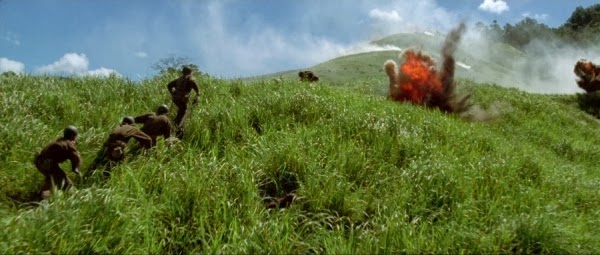
Twenty years would pass until his next feature, which I would consider to be his best, The Thin Red Line. It featured a star studded cast led by Sean Penn. Following this film, Malick's work became more elliptical. Now his films consisted of an unceasing montage of image and sound. It is a second world war film, following the treacherous battle of American troops against the Japanese in the South Pacific. 

It is a very literary film, following multiple perspectives and interior thoughts. It is very dynamic both because of its multiple perspectives and because of the beautiful, swaying camera which veers and rotates around these wrenching battles. The perspective alternates between the soldiers, who see the battles with anxiety; the natives, who feel intruded upon; and the army officers who have an implacable thirst for battle. Like Kubrick's Paths of Glory, Malick sees these kinds of military ventures as immoral and as needless loss of life. The film hardly results in easy viewing, the level of bloodshed being stratospheric, but the dynamic way in which Malick approaches the material transcends the viewer in a way few such war films do. It came out around the same time as Saving Private Ryan and identified itself as its more intelligent art-house cousin.

Now drama and narrative flair became of little importance to Malick. The images were now accompanied by cryptic poetic epigrams. Cinematography and narrative now became dislocated. The montage of visuals stretched for long periods, with apparent disregard for narrative or character development.


The Thin Red Line, 1998

Following The Thin Red Line, certain people thought that Malick had become self-parodical, a cheap imitation of his former glories. This was the criticism some leveled at The New World (which I haven't seen). It was also what some people said about the otherwise acclaimed The Tree of Life. This was his most ambitious film to date, attempting to scale heights few people dare aspire towards. It followed the origins of the cosmos in counterpoint to the family life of a Christian family (drawn from Malick's own childhood). Malick shoots hours and hours of footage and what we see is the cream of it. The epigrams which featured in The Thin Red Line reappear, this time voicing Christian reverence and belief. These can often sound platitudinous at times and I am sure swathes of people dismissed the film as high-minded humorless nonsense. Whatever its failures, its technical brilliance is a true sight to behold.

To the Wonder came only a year or so later. It featured the more cringe-inducing aspects of Tree of Life and, for the first time in Malick's career, its release fell to an indifferent silence. I saw it at a cinema and I was agog by it. (By all means, if you ever get to see a Malick film in a cinema, do so.) The shots of cathedrals, coasts, meadows are sumptuous to see in the big screen. Semantically, the film says pretty trite things about 'love'.

For all these later releases, Malick shoots hours and hours of footage. When it comes to editing, he leaves huge star actors out of the film. (Many have since stated that they will never work with him again.) Although Malick works with star actors, I see him approaching them the same way Bresson approached his 'models.' He does not use them as actors, he uses them as mere bodies to be framed within his visual paintings.

So, is all that he does now is navel-gazing? I think not. Malick is a master, who makes spiritual films that reconfigure the quotidian into great beauty. Let's thank our lucky stars he is around.  

Monday, 16 September 2013

Musical despots

An author imprints his ideas and personality onto the text. These are channeled directly to the final work. Although a copy editor may make minor modifications, the central thrust of his creative vision is entirely his own. A composer, similarly, crafts every detail and nuance of a musical piece. The final score is his, however radically an ensemble may choose to perform it.

Collaborative projects, generally, do not interest me as much. I generally find it more interesting when an individual takes over the collective and shapes it according to his artistic vision.

Many such ventures start democratically. Soon enough, however, the fledgling dictator mounts a coup de etat and becomes the leading musical director. Captain Beefheart & His Magic band started with all members on equal terms. Soon enough, Beefheart fired his band and acquired an impressionable crop of younger musicians who would do whatever he wanted (they would also be less resistant to the idea of playing 'weird' music, instead of the blues standards the first Magic Band were keener to perform).  The Fall also had a similar development. (The young roadies who handled the first group's equipment soon found themselves on stage performing the music.)

The leading despot often tries to manufacture the oddest stage act. One of the most striking examples is that of the avant-jazz titan Sun Ra. Sun Ra claimed he came from Saturn (a gas planet?!). Although this may seem as mere promo talk, he staunchly defended this claim. Once he was put under hypnosis and, lo and behold, he still claimed that he came from Saturn.


Sun Ra

His group was called the 'Sun Ra Arkestra.' Originally it started as an ensemble which would play swing and old-style big band jazz. Soon Sun Ra began to implement unusual rhythms, time signatures, noises, chants, Egyptian melodies and astringent solos in what became a fascinating sound world.

This was a enormous ensemble, comprising way over twenty members. They were all ensnared in a small house, adhered to Sun Ra's cosmic claims and were never allowed to contact family members or friends. Even more strikingly, if Sun Ra was dissatisfied with the performance of a member, on a world tour he would often desert him and leave the member stranded in a foreign country. (The CIA soon told him that he would have to stop this habit.)

Of course, there were Beefheart's antics during the rehearsals of Trout Mask Replica which have been documented in an earlier post. After the coup de etat mounted by The Fall's Mark E. Smith, he has continued to exert his rule for over thirty years. He fires members at will, subjects them to his erratic behaviour and, although most of the band members share song-writing credits, if you don't do as told you are most certainly fired.


Mark E. Smith

Although the music itself may be composed or arranged by the ensemble, it is generally steered by the leash of the leader. It is interesting to note that none of the members who have left Captain Beefheart or The Fall have ever produced any material of worth. John French may have masterminded the arrangements of most of Beefheart's music, but his sporadic solo work is generally bland and hardly ever memorable. The numerous members that have left The Fall disappear and never leave a trace. Hardly any group of an ex-Fall member has made a strong impact.

But it is an interesting symbiosis. Although the leader is the centre of attention, the project can never survive or work without the backing band. Without his herd of acolytes and slaves, the despot is rendered helpless and impotent.

Generally, these projects bear the idiosyncrasy of the maker. It is also an interesting work ethic. Most jazz leaders employ a group of musicians, take them on world tours but they work under the constraints of his regiment. Miles Davis, of course, worked with the greatest luminaries in jazz. All his work bears his own language, in all the eclectic genres and crossovers he worked in. 

So, the advantages of musical despotism are manifold. Their backing groups do bear the brunt of their tempers, so we must all acknowledge their hard work and input (after all, many of these groups are subjected to strenuous rehearsals). Many of these unique individuals do recognise, however, that sometimes creativity does not always work in the name of democracy.

Sunday, 8 September 2013

Conversation with Douglas Farrand

Douglas Farrand is a composer who just completed a degree in music composition in the USA. I have kept an online correspondence with him of some sort or another since my mid-teens. You can read his blog here.
A very perceptive guy capable of great insight. I thought it would be nice if we sent each other a series of questions about our creative projects (his music, my writing). I thought it would be great to bring in different voices to my blog, rather than my own monotonous rambling.
-------------------------------
My questions.
Are your influences exclusively musical? Are you an additive person? Do the interests you go accumulating over time inform your musical work?
Definitely not exclusively musical- although I listen to an awful lot of music, new and old, and am definitely influenced by what I'm listening to- particularly the music and ideas of close friends. An additive person? I suppose so- interests come and go, many return, are compacted/become folded into other preoccupations.
To what extent is your music a political statement?
Hugely complex issue- I would say- not at all a statement, and rarely political in a sort of explicit sense- but its quite possible to engage with the politics of any action- including the making of music. Thats always an important conversation to be having- and not something I'd ever turn away from.
Do you think music is, to quote Stravinsky, "incapable of expressing anything other than itself"? If music can express grander non-musical ideas, what are they?
This is also a question that becomes uncomfortable quickly- at which point its important not to assign music any agency at all and instead to look at the ways we understand music- which are myriad.
How essential is silence for you in your work?
Its a complex and multifaceted concept relevant to so many experiences- definitely an important part of my listening and composing.
How important are urban city noises in your work? / How important are rural countryside noises in your work?
Important in so far as listening is important to me. I try to be involved with music in a number of ways- writing music, playing music, writing about music, thinking about music, etc. - these activities can all be quite different, but are all centered around a sort of basic practice of listening.
When you start a new piece, do you start with an abstract concept or a more rigid structure? Or both?
Both.. neither... one or the other... pieces start from many directions- sometimes they don't start at all but grow seamlessly out of a previous project. When I was just starting to compose alot of my composing started with both- a concept or an idea, and a formal-structural model (a sort of temporal architecture)- writing music was a very top-down activity. There came a point where working this way consistently proved frustrating and unproductive.
Do you think music can be redemptive? Many music lovers feel this way about music. Do you, as a composer?
It seems perfectly reasonable that a person might feel in some way redeemed when listening to music- but that is much more to do with how that person responds to themselves in that moment than it is an intrinsic quality of music.
Do you think music can be transgressive? Have you ever set out to be deliberately transgressive? Or have you often found yourself trying to appease others?
Transgression is not something I set out to accomplish- neither is appeasement. Writing music is, for me, much less to do with an audience than it is a community that I am a part of and contribute to- it is this commitment to and exchange of ideas and experiences that cultivates a rich, creative discourse. I think it is beneficial to all involved to leave consideration of an abstract audience behind us.
Are you a 'perfectionist' in any sense? Do you demand accurate performances of your work? Or are you happy to settle with performances which may have a few imperfections?
Not a perfectionist- in most instances 'accurate' is a vague and dynamic concept with regards to music, which also means that this idea of 'imperfections' is not really a relevant one. I am more or less content to see what happens- to enjoy what happens. What I care about is more the state of the relationship between me and people playing my music- I hope that relationship- whatever its specifics- can be open and engaged. If that is the case, the music will take care of itself.
Do you think there should be more of a cross-over between the 'serious' music world and the 'popular' music world?
On one hand, there seems to be plenty of 'cross-over'. It seems to me more of a challenge today to NOT be exposed to a huge number of different musics, than it is to have that exposure. This said I do find many of the binaries drawn, terminologies used, and positions forwarded by the idea of 'cross over', 'serious music' and 'pop music' to be problematic.
As examples of music that comes from a perspective on this issue that I find exciting- I'd say 1) improvising ensemble AMM (I remember reading a great statement, I think by Keith Rowe, either in an interview or in the Cornelius Cardew biography, about the notion of influence in AMM's music... too tired to try to paraphrase now but if I find it I'll let you know), and 2) Michael Pisaro's Tombstones pieces (which can be heard/read about here: https://soundcloud.com/human_ear/sets/michael-pisaro-tombstones

-----------------------------------
Doug's questions.
What are your thoughts on literary curation?

To be perfectly frank, I do not think very much how my writing would be disseminated. The only realistic way to get your first book published now is online, through E-books, or whatever the fuck it's called (I'm out of step with the times). Personally, I prefer print books - I like the tactile experience of holding the book. But that has no bearing how the text interacts with others, it's just a preference as regards presentation.
What I like about literature is that you can inside the consciousness of another person. That magazine I was published in, for example, has a circulation of 1.000-2.500. It might sound very stingy, but I was actually thrilled that quite a range of people accessed my imagination.
I very much like home-grown stuff, too. The books I put together, for example. I never charge for them either - it's more genuine that way! There's something quite quaint about binding a few pages together and giving them out to a handful of friends.
I have no qualms with commercial/corporate publishing - in fact, if it reaches more people, the better. An editor would actually help polish my cluttered writing. If they were to slice substantial sections, then I would start getting worried!
I have no preference as regards demographics. I'm not part of a community of like-minded people. I do not write for a specific readership. Anyone curious and broad-minded enough to make the effort, should read it.
Having said all that, I truly doubt that my writing would ever have broad appeal (not that it's an ideal of any sort anyway!) My writing is too obscure and particular for that. When I produced a more conventional story, it was published! No-one really wants to get their hands near my more eccentric peculiarities. Not that it matters - literature, to me, is expiation.
Where does the drive to write come from, for you? Is it an excitement about language? Narrative? Sound? Reading?
The answer to this is four-fold: 1) I want to create some sort of beauty out of language. My writing is poetic in the sense that the cadences/rhythms in the words have the same kind of metrics as poetry. Yet, at the same time, whilst having these qualities, it is largely descriptive. I rarely use metaphorical language. I want to have the cadences of poetry deployed in prose without metaphor/simile etc. 2) Conceptual ideas. Often stories originate with a need to address a philosophical/political/theoretical/existential etc. etc. ideas. The narrative in this case is buttressed merely to sustain the subtext. The ideas I have explored are myriad: political contingencies and how they affect our private lives, philosophical/intellectual conceptions about the afterlife, partisan/subversive practices in literature and the arts, etc. Fiction is such a malleable/flexible form that you are free to latch on your ideas in this fashion. Of course, it is more suitable to do this in a novel than a story (which is meant to be compact). 3) Narrative. I used to be really into writing non-linear narratives, but of late they have been linear. My recent stories have been shorter and I have paid greater attention to the idea of getting the timing/suspense right and then revealing an unprecedented twist. I love Poe, Borges, Kafka Cortázar etc. because their stories are so unprecedented/surprising. I often try to create the same effect in my writing. 4) Consciousness. I used to see characters as mere devices to carry plot forward. Now I really creating psychological movement. I really like heightened/extreme states of mind that verge on the pathological. As a whole, the people who are interest me the most are those who are fucked up in some way, not normal folk.
Does writing come easily to you? Do you work on or off the page? Do you use any constraints?
I'm quite fussy - I can only write in the library, with no distractions. When I'm there, I usually write without difficulties!
I'm not such a methodical planner. Usually the structure of the story is laid out in a page of A4 - and that usually just details plot summary.
I don't use constraints. Actually, as opposed to music, there aren't swathes of writers who use rigorous constraints. Perec wrote a whole novel without the letter E - which, to me, strikes me as a bit of a daft practice.
Writing is a constrained practice by its very definition. Writing in any given genre is a constraint. Simply trying to adhere to that page of A4 is constraining!
A lot of what surfaces in my writing is done on the page, rather than off. In fact, that what makes writing so darn entertaining.
Do you write to be read or heard? Or both? How do you navigate the experience of reading the written word vs. hearing the spoken word?
Read. I've never written anything with the specific intention of having it spoken out. Though I've since found that my writing adapts well to this medium. (This is because of the way it flows - the rhythms/cadences I likened to poetry.)
There have been a few occasions where I've recorded my stories. I've done in a rather exuberant way. That was just spontaneous. When I read them out to a group of students or whatever at a workshop, I'm usually wimpy. Alas!