Monday, 25 January 2016

Ahoy Facebook #2

Bits and pieces. Left-overs. Call it what you like. 

**********************


What good is intellectual masturbation? What's the point in analysing all of the complex proxy wars in the middle east to death when none of this intellectual masturbation/theorising will translate into concrete policies which will help the poor people over there? What's the point in reading so much philosophy when, millennia after Socrates and all these people, no-one is altogether clear what the real use of it is? What's the point in me writing a strange and complex novel that no-one will care to read? Aiiii.... I'm useless and all of my interests are useless and nothing I will do will contribute one jot to the well-being and welfare of others.

**********************

I regret not listening to as much jazz as I used to. Something I've especially neglected recently is the more avant-ish variety. The past two/three years I've been gorging myself on the earliest stuff - everything starting from 1920s New Orleans jazz, ragtime etc. to big band 50s swing. I'm glad I did, because I found to my delight I found that a lot of that stuff is really good. I'm trying to listen to more freestyle/avant variety jazz more often now. What I find about most free improv is that you really have to be there in concert. On record, it's largely forgettable, meandering and can even be a bit of a headache. What I find is that there is a new breed of avant/free improv music which tries to integrate more tonal stuff, harmonies, actual chords etc. into the music. When I'm in Canterbury, I go every week to a concert of free music called 'Free Range' and I find most of the music there to be of interest. By inserting more 'musical' elements into the soundscapes, does it cease to be as 'free'? All that rigid terminology is such utter nonsense. I always thought that the ethos of free jazz was the freedom to play whatever one wanted, whether it meant playing in key or out of key, a ballad or a noisy clump of random notes. If hardcore free improv says 'no, you can't play in key or any chord - the whole point is that this is a process where we forget how to play in a proper manner' - that's just utter silliness. Completely childish dogma. I recently discovered Mary Halvorson and I really like her stuff. She is quite versatile on the guitar and has a unique style. What I like about her stuff is that it embodies the spirit of free jazz I mentioned above. She is keen to try anything of interest in any context. What you find with younger generations is also a tendency to play in 'punk' contexts and to infuse it with jazz. Her stuff also always has technique. When she plays in a looser style, there is always a sense of structure, too. I particularly like this track.


**********************
I hate Richard Linklater's films with a passion. Unironic, nonglorifying, non-critical, naturalistic treatment of pseudy, edgy, bohemian, nose-pierced (and-everything-else-pierced) youths who quote Bukowski and Kerouac whilst chasing girls and riding cars all day long. This is peppered with a liberal dose of platitudinous soppy statements about relationships and love. The arthouse equivalent of a Kodak ad.

**********************
I think that I have found the most pointless word in the English language. I had seen the word 'Defenestration' here and there and the first thing I thought one morning when I woke up was 'I wonder what "Defenestration" means?' (As you do.) It so transpires that it involves throwing a person or an object out of a window. Do we really need a word for that? If I happen to throw something out of a window, I will just say that I am "defenestrating." Hang on, is there even a verb for it?!

https://en.wikipedia.org/wiki/Defenestration


**********************

I am undergoing a bit of a seismic shift. I would rather read the Holy Bible, Greek philosophy and Shakespeare than spend all day trying to get my head around Derrida, Deleuze and Foucault. (Those 3 thinkers are just not worth the work for me and, even if you synthesise their arguments into something easily comprehensible, I still don't find them at all interesting.) I would rather listen to Bach, Beethoven and Schubert than spend a lot of my time looking for obscure and weird bands. (There are a lot of weird and wonderful bands out there, but I have to sift through a lot of unlistenable and pretentious crap to find them. Why would I want to do that when I can listen to a nice piece by Bach?) When it comes to printed media, I would rather read a mainstream newspaper than some arcane magazine about strange art. I guess that this is what it means to grow, develop and mature. It can only be a good thing.

**********************
Doing a job application correctly involves striking a fine balance between writing the most stomach-turning platitudes, insincere arse-licking and projecting an insincere, almost narcissistic sense of self-esteem.

**********************

The events in Paris compounded my frustrations with the 'hard left.' It's almost as if a lot of people wait for these events to happen so that they can simply push a button and wait for all the same tired arguments to come out. There's a lot of truth in the fact that, say, that Isis targeted France because they tend to marginalise minorities, they support wars in the middle east, that the media focuses on European terrorist attacks as opposed to covering those that take place in the middle east etc. etc. But if you just drive that home again and again, you end up with a very biased, simplistic, black-and-white view of the world. Saying a lot of these things a lot of the time hardly involves any observation or analysis ('empiricism,' if you like). It simply involves someone saying 'I believe this - this is my view of the world - hence, these terrorist attacks mean this.' When terrorist attacks happen, I would rather that everyone felt sombre, absorb what's happened, take time to reflect and empathise with the bereaved. After a few days, I would feel that it's more appropriate to start to discuss, analyse and interpret. That kind of emotional response is better than equally emotive knee-jerk reactions. It's better than scapegoating the media and western governments and it's much, much better to respond like this than those horrible, toxic hawks who say 'these muslims hate our values (they hate freedom, equality and fraternity!). We need to marginalise them and, better still, wage wars against them in Syria and Iraq.'
**********************
If there's anything I can take away from losing 3-0 to Uruguay is that it bestowed upon the world a piece of comic wisdom. This is especially given that Uruguay are the South American team I hate the most. Come to think of it, they are the only South American team that I hate. I really like Peru (determined and earnest) and Argentina (have always loved their combination of technique, speed and passion. Plus, without Argentina's footballing qualities, Chile would not play the way they do now). Uruguay are just a bunch of overrated wankers who rely on getting getting the luck of the draw. All of their accomplishments in the past have been nothing but flukes. They were lucky to win the 1950 world cup (easy draw on the way and Brazil got nervous in the final and crumbled) and to finish 4th in 2010 (look up the teams they played before the semi-finals - South Africa, that woeful France team, an under-par Mexico, South Korea and Ghana! Come on!) Not only that, they are dirty buggers who foul, cheat and resort to the scummiest tactics to win. When they get a dose of their own medicine - as they did with Chile in the last Copa America - they don't know how to take it and they cry like little school girls. Anyway. Following the loss to Uruguay, Chile's lovable manager Sampaoli made an analogy to describe why possession really DOES matter. Chile boasted 73% possession yet STILL lost 3-0. Counter-productive, no? Well, Sampaoli said the following: 'One night, I went to a bar, I was with a woman. We talked all night. We laughed, we flirted, I paid for several drinks of hers. At around 5am, a guy came in, grabbed her by the arm and took her to the bathroom. He made love to her and she left with him. That doesn’t matter, because I had most of the possession on that night.” Ha! That has to be the best defence of possession football ever! Van Gaal has tried in the past, but it falls flat. It was a humiliating defeat, but it DID leave behind a genius, and hilarious, analogy.

**********************

Auster is pretty much stating the obvious here, but it resonates a lot. In fact, Auster is pretty much the consummate 'boyish' writer - the kind of writer that the intelligentsia will laugh at you for reading and will promptly ask you how old you are. I've pretty much always been attracted to the modern/post-modern 'boyish' writers - i.e. dicking around with narrative, absurd scenarios, rehashing existing novels, etc. It's strange to define it these literary genres by gender, but that's all very male - boyish, rather. It's like a geeky fascination with literature, not some sort of grand quest for truth or meaning or whatever. Again, this is very reductive, but female readers tend to read female authors and they don't always go for all of that post-modern stuff. Older men usually say 'I'm too old for this - artifice gets old quickly - I would rather read Dickens.' I actually hardly read fiction anymore. I'm reading more philosophy, politics, bits and bobs of history, social commentary, religion, etc. Still, I find that the real reason why I amass all this disparate information is so that I can dick around with it in my own consummately boyish attempts at fiction.

http://www.huffingtonpost.com/anne-margaret-daniel/paul-auster-on-boy-writer_b_4670507.html

**********************

Jonathan Coe is a writer I have taken an interest in lately, especially after I read reviews for his novel 'Number 11.' He writes satires about contemporary UK and critiques its commercialism, individualism and lack of compassion. He writes with nostalgia about the post-war consensus and hence has been called 'a conservative leftist' or 'reactionary socialist.' All this bodes very well with me, but he went from the 'interesting-I'll-keep-an-eye-on-this-category' to 'this-guy-is-amazing-category' after I heard that his favourite album of all time is also 'Rock Bottom' by Robert Wyatt. That album has such a special place in my heart and, whilst I have heard the odd person here and there claim they like that eccentric 1974 release, I haven't heard anyone else also claim that it's their *favourite* record.

https://www.youtube.com/watch?v=5utd3TdIvUM


Monday, 18 January 2016

My favourite films of the year, '15

Here it is. My yearly list of favourite films.

Although several of these films were released internationally in 2014, this list cover films which received a theatrical release in the UK in 2015.

10. Best of Enemies (Documentary) (Robert Gordon and Morgan Neville, USA)

Gore Vidal and William F. Buckley seem like bickering twin brothers who are poles apart. Vidal was seen as a totemic figure for the left, Bucley was one for the right. They went head-to-head in a series of debates for the Rebulican presidential nomination in the run-up to the 1968 election. They were both consummate WASPs and public intellectuals. They were verbose, incredibly pompous, upper-lipped, patrician and supercilious. Although they both came to embody a certain economic class, politically they were diametric opposites.

The film, like many of these type of documentaries, is fast-paced and great fun to watch. The visuals and the talking-head formula are a little staid. However, the film is very interesting in the way it explores how Vidal and Buckley informed the arguments we have today. The debates might seem like a very obscure moment in history, but the directors make the effort to make them relevant. Vidal, ultimately, won the social argument. Socially, we are very liberal. His ideas about sexuality and transgenderism, based on ideas from antiquity, were very original and are now common-place. Buckley, undoubtedly, won the political and economic argument. Vidal was weary of the increasing power that multinational companies were already enjoying. Buckley was leading these debates with his magazine National Review and ultimately helped put Ronald Reagan in the White House.

For purely entertainment value, this makes it into my list. Seeing the debates in the cinema was great fun. (I had seen them on You Tube before - whilst procrastinating, usually!) Vidal and Buckley were learned wordsmiths and this hence made for great theatre. The debates usually degenerate into ad-hominem attacks. This is most notable when Vidal calls Buckley a 'crypto-nazi' and Buckley simply loses it - polysyllabically! The film ends by claiming that this lowered the standard of debate and that it foreshadowed news outlets like Fox News. Political debate, ultimately, became more partisan and binary. This does strike me as a little tenuous to be honest. These debates were led by far more colourful and learned men than, say, Bill O'Reilley.

9. Queen and Country (John Boorman, UK)

When I first saw this in the cinema, it struck me as an ok period drama. The reviews in the media said as much. Images of the film lingered in my mind and, having seen it for a second time, I realised that it was so much more than this. Whatever its flaws, I am certain that it will be reassessed in the future.

The film is drawn of memories that Boorman has of being in his twenties in the early 1950s. Everyone had to do military service at the time and he was hence conscripted to fight in the Korean war. What made the film especially moving to me was the fact that these are actual memories of someone who lived through the period.

The film documents a lot of the social changes going on at the time. The central character is based on Boorman. There is a sense that a kind of deferential society is being overturned. The young characters are especially contemptuous of the officers who, with their plummy voices, represent an ageing patriarchy about to be overturned. At what point the main characters snaps back at one officer something along the lines of 'your England has now ended.' There is a sense that new economic freedoms have arisen. The character has a keen interest in film. New careers in new sectors for all classes seem possible. Also, although not a permissive society, the characters are keen to defy any kind of moralistic attitude towards sex. The death of the king and the anointment of the queen is the symbolic of the way in which this patriarchy of plummy old men had given way to a new generation of idealists.

Boorman looks back on a 'lost love.' It is interesting that these memories are clearly subjective. The character, dubbed 'Ophelia' after the Hamlet character, is beautiful and exceedingly intelligent. Constant mention is made of the fact that she is 'too good' for him. After the passage of more than half a century, Boorman has clearly idealised this woman. The period is idealised and evoked nostalgically and this is what makes it a special film for me. It is one person's subjective account of the post-war years. It is perhaps a bit over-acted and episodic, but it's still a great film.

8. Timbuktu (Abderrahmane Sissako, France/Mauritania)

This is a drama exploring the hold that Muslim extremists have in Mali. It is a melodrama of sorts. The film, appropriately, employs a lot of humour as well. Groups such as Boko Haram and Isis are ultimately comprised of silly and asinine young men. I heard a pundit recently make the analogy that a lot of them go there so that they can re-enact video game 'shoot-em-ups' in real life. The film, appositely, humanises them and shows them to be stupid. Still, the film is a bit overwhelming to watch in that it doesn't flinch from portraying how normal people are affected by their authoritarian ways. There are some pretty lurid shots of stonings. The film shows how the Islamists clamp down on any type of expression, including music. It shows that their standards are completely arbitrary and that they are theologically illiterate when it comes to Islam.

The film is really nicely shot. There is a sense of joy when we see the inhabitants enjoying moments of reprieve, be it through playing football or playing music. (Malian music is really lovely.) There is a lovely tracking shot of a group of people playing football without their confiscated ball. When discussing Islamism, it is tempting to view it abstractedly. In this film, everyone is human. As such, you have a mixed bag of emotions. There is terror, there is reprieve, sporadic moments of joy and utter grief. This is the most appropriate treatment. The story is resolved with the central character being executed, which perhaps emphasises the utter sense of hopelessness and despair in the region.

7. The Tribe (Myroslav Slaboshpytskyi, Ukraine)

This film is entirely in Ukranian sign language. This has a Brechtian effect, where you are distanced from the events taking place. The director mentioned that deaf-mute people themselves have been alienated from films from time immemorial and this is the first time that 'normal' people have had the same experience.

The film, thankfully, is easy to follow. I found it to be extremely visceral and stimulating. To use a crass metaphor, it's somewhat like being punched in the face, only in a good way. The film shows how deaf-mute students become embroiled in gangs, street-fights, sex and abortions. It's like this is a grimy subculture of another grimy subculture. This is where the Brechtian element comes in. Abortions, street-fights and under-age drinking are endemic in Ukraine. Through the use of sign language, it alienates you from it and makes you see it from another angle.

The cinematography is also wonderfully inventive and often shows many events taking place concurrently. This is another 'alienating' technique. The film is emotionally involving, but it stirs your emotions in a way that other films don't.

6. The Look of Silence (Documentary) (Joshua Oppenheimer, Denmark/Finland/Indonesia/Norway/UK)

This is Oppenheimer's sequel to The Act of Killing. Tellingly, the film received a 'silent' response and didn't receive anywhere near the amount of adulation that it predecessor did. Whereas the first film was a deliberately histrionic and flamboyant affair, this one is more quiet and introspective. The first film was staggering because the killers did not exhibit the slightest compunction, even when re-enacting the murders of alleged communists in Indonesia. This film is from the perspective of the victims. The son of one of the victims finds out how his father was tortured. He tracks down several people and awkward exchanges ensue. We see snatches of guilt. However, the film shows the sense of regret and injustice that the victims have experienced. The son of the victim frequently presses them and often starts a lot of moralising. He tracks down as many accomplices as he can. However, there is a sense that their mood of blithe indifference is too entrenched. His own son is shown in school where he is taught how the US-backed coup had a benign influence. They are taught as to how communists used to slit people's throats and cause havoc.

The tone here is one of quiet introspection tinged with rage. We probe a lot deeper into the minds of the killers, too. If the previous film left me feeling a little sick, this one provides a bit of vindication.

5. Pasolini (Abel Ferrara, France/Italy/Belgium)

This film recreates Pasolini's final days in the mid 70s, where he was murdered by a homosexual gang. The reasons why he was murdered are unclear. He was a raconteur, a Marxist and had just directed a gruesomely pornographic adaptation of 120 Days of Sodom.

 Pasolini was a poet, short story writer, journalist and novelist as well as a film director. I am particularly interested in films that imaginatively recreate the writing process and this is one of them. Scenes of Pasolini working on his desks are interwoven with recreations of his short stories. There is a sense of apocalyptic gloom in the air. Pasolini has ideas about an imminent collapse of the global economy and, by the time he is murdered, it seems like a voluntary attempt at martyrdom.

The film is nicely shot and I liked the use of Bach. (It something of a cliche to use Bach in arthouse cinema, but nevermind. It works.) I have read that it is helpful to have prior knowledge of Pasolini, though I was taken by the recreation of his fantastical short stories and I am not familiar with his work. Defoe's performance is appositely subdued. The causes of Pasoloni's death are still subject to interpretation. Defoe's Pasolini is reserved and doesn't give anything away. Ferrara, apparently, believes several conspiracy theories about the murder. For the film, however, he leaves everything clouded in a miasma of ambiguity.

4. 45 Years (Andrew Haigh, UK)

Cinemas are something of a secular temple for me. I have grown especially fond of 'slow' cinema. It has an almost mystical effect, especially when seen in a cinema. The world is fast and frenetic, flooded with news and social media messages. Slow cinema, perhaps more so than any other creative media, has the potential of slowing everything down and make you contemplate.

This is a film about a week in the life of an ageing middle crust couple. They are shown coping with a revelation the husband makes. They have a celebration for their anniversary. The film ends.

This is perhaps a British equivalent of Ozu. It shows the nuances of a certain class and a certain type of relationship. It doesn't spoil it with too much narrative. It is a very life-affirming film of a very ordinary type of relationship.

 3. Inherent Vice (Paul Thomas Anderson, USA)


They finally did it. They brought Thomas Pynchon to the screen. Anderson's adaptation is joyously convoluted and meandering ride through late 60s America. The lead character is a stoned hippie who is also a private detective.

I loved the way the film retained Pynchon's bizarro humour and the perennial presence of vague subplots you don't quite understand. There is a therapist who encourages teenages to take on 'sensible drug use.' There is a strange mystical sect. A stash of drugs is held by a yacht. It is clearly set in a post-modern world where everything is askew and artificial. Yet, strangely enough, it seems somewhat feasible in that it might well be the memories of someone who was too stoned to remember them.

Pynchon is clearly nostalgic about the era, its sense of humour and its misplaced idealism. The hippie dream collapsed on itself because it was not sustainable. Anderson shares this nostalgia, with saturated shots and a wistful soundtrack. There is a sense throughout the film that the idealism has lapsed into a type of drug-induced paranoia. The love generation, aided by its prodigious use of drugs, was about to lead towards Charles Manson. Pynchon's novels are suffused with a sense of paranoia about government agencies and secret sects. Here the paranoia is drug-induced. Everywhere the lead character turns, there seems to be some sort of conspiracy and it all appears to be led by the government or forces beyond his control.

2. Carol (Todd Haynes, USA)


Carol has being called a melodrama. Narratively, performance-ways, dialogue-wise, it seems perfect. Although it's a melodrama, it's maybe the first time this type of film in a way that didn't leaveme feeling cheated afterwards. I didn't feel like heart strings were being moved by something hokey and third-rate.

The film is based on a novel by Patricia Highsmith. It is set in the 1950s and deals with a lesbian relationship. It is a highly puritanical society with normative values about heterosexual relationships. Interestingly, the film doesn't see the idea of sexuality as being innate, which is the view we normally hold now. Sexual identity almost seems willed as a way to defy a conformist society. Although films of the time were definitely 'male gaze,' this film is simultaneously 'queer gaze' and 'female gaze'. The shots definitely are mediated through the perspective of these oppressed characters.

The mise-en-scene perfectly recreates the period of the epoch. Cate Blanchett's performance is flawless. This is a film that would overwhelm anyone.

 1. The Salt of the Earth (Documentary) (Wim Wenders, France/Brazil)


This is a documentary about the Brazilian photographer Sebastiao Salgado. It tracks how he left a comfortable career in finance for his photographic pursuits. He travelled across South America and later East Africa to document his ethnographic interests. Later on he developed an interest in nature.

This film works on so many levels. There is a somewhat of a philosophical undercurrent. Salgado has been turned into a pessimist by his travels. In his travels towards 'the heart of darkness,' he finds malnutrition, decay, death, etc. He says that this development can even arise where living and education standards are better, such as Yugoslavia. All this took place during 'the end of history,' which reinforces the utter blitheness and utter carelessness of the term. Humans are ultimately powerless when compared to immensity of nature and the hold that multinational corporations have over us. The film works on a anthropological level, with Salgado's photographs acting as a kind of document of the codes and practices of certain tribes. It also works on aeshetic level, with his photograph of the war in Kuwait revealing an element of the sublime with the depiction of the destruction of an oil rig. There is also definitely a personal element, as Salgado recounts the difficulties of having to live apart from his wife and son. There is also a moving account of how he grew to have affection for a child he had who was born with Down's Syndrome.

Everyone who saw this in the cinema was absolutely taken aback by it. It worked on a lot of levels and it was beautiful to look at. There is a sense in the end of what a fruitful existence Salgado has had and also of the limitless experiences to be had with several cultures and with nature.

Wednesday, 6 January 2016

The physiognomy of football managers #4


Attack! Attack! Attack! Run! Run! Run! Mauricio Pochettino's teams do a lot of running and a lot of attacking. Their work-rate is phenomenal. It all seems far too much for the main man himself, Poche, to handle. He looks like he is about to have a panic attack. You can tell that he is a quiet, albeit nervous, chap. You can tell he is really passionate about what he does, that he is an obsessive. He is a bit like me, really.

Poche is from a humble background, having grown up in a poor town near Rosario. He was scouted by his mentor, Marcelo Bielsa, to play in the Rosario team Newell's Old Boys. He derives his tactics from 'El Loco' Bielsa, although he is more pragmatic when implementing them. Again, Poche is another example of someone marked by his uprbringing. Although he enjoyed a playing career in Europe, he is not at all flamboyant with his gestures. He is to the point. He does not talk at all about his private life. He is in the football stadium to one thing and one thing only: win a game of football.

Yet for all his humility, Poche isn't without his ideals. He is an idealist. He does want to achieve great, big, unheralded things. At the same time, he is down to earth about it. We can tell this we look at him. (Again the same shtick!) We can tell from the look in his eyes that he is driven to win big things with risky tactics. He is full of nervous energy - and he wants to transpose that nervous energy onto the pitch. Indeed, his teams are frenetically fast. Sadly, they often end the season having run out of legs. We can also tell that he is down to earth  in that his gestures and hand signals are kept to a minimum. We sense that he gets close to the pitch simply to let the players know that he is there. With his nervous demenour, however, could this have an adverse effect?

It's finally beginning to work with Spurs. They really are beginning to resemble their manager - at long last. If there's one team that lacks graft, it's Spurs. They now have both guile and graft thanks to their exemplary manager. If there's one key word that recurs in his press conferences, it's 'a philosophy.' This shouldn't be taken as a sign of pretension. Rather, it should just reveal that Maurcio Pochettino is a man of integrity and principles who wants to achieve great things playing the way he wants to play.

Tuesday, 5 January 2016

The physiognomy of football managers #3


Do you need some sleep? Would you like to take a rest? Manuel Pellegrini does look awfully rough. It seems like he has stayed up the whole night thinking about the match. But then, Pelle isn't the nervous type - quite the opposite. He's quite likely the calmest, most subdued manager in existence. We would assume that, prior to a football match, he methodically studies stats about the opposition. They contain a lot of curves and angles and equations that we mere mortals would never be able to fathom. He could also do with brushing his hair now and then.

Curves and angles. For indeed, Pelle is called el ingeniero - the engineer. He has an undergraduate degree in industrial engineering from Chile's most prestigious university, Universidad Catolica. He is definitely among the more cerebral and analytic managers out there. This is why he is likened to Prof Arsene Wenger. There are notable differences between the two, mind you. Wenger gets angry and often loses it. He is prone to making pissy statements in front the press. He often jumps around the touchline and waves his arms a lot.

And Pelle? What can we say about Pelle's touchline physiognomy? Well, we have already established that he looks rough, with his blood-shot eyes, messy hair and bored expression. Other than that, he does remarkably little. He sits motionless on his seat and rarely consults his assistants. He occasionally wanders close to the pitch and stands with a bored expression in front of the pitch. His physical expression communicates nothing.

This is exactly what Pelle does in press conferences, too. He literally says nothing at all. He'll say stuff like 'We played well. We deserved to win' or 'I did not think we should have lost because we played well' with a thick Chilean accent. This is all strategic, however. The idea is to say nothing and to give nothing away. He completely rejects the theatrical side of football management. When he was asked why he is not very animated on the touchline, he replied with something like 'I am not a clown. You do all the work for a game of football a week before in training. There is nothing you can do from the touchline.' (He did say this in Spanish, however - his first language. His English really isn't that good.) 

Pelle might look like he does not care when he speak and moves. Yet he also has a look of steely determination. This paradox we sense when we look at him is reflected completely by his work ethic. His ethic is 'work hard - play soft.' Indeed, although he works awfully hard, he does nothing on the touchline. It must be noted that, although Pelle is fond of fine arts, literature and culture as a whole, he is not intent on letting everyone know about his tastes. The man is the antithesis of a ponce. We are also very lucky to have him in the Premier League. I'll miss him when he is gone, but I bloody well hope he manages the Chile national team next.

Sunday, 27 December 2015

The physiognomy of football managers #2


Should we call him 'Roberto' or 'Bob'? Indeed, Roberto Martinez has spent virtually his entire playing and mangerial career in England. He is 'Anglo-Spanish,' rather than 'Spanish.' Can we ascertain this when we look at him?

It must be said, though, Roberto seems more 'Spanish' in appearance - and this indeed is reflected by his teams' style of play. Roberto has helped make English football 'sexier.' This is evident when we look at Roberto's physiognomy: he sports an immaculate suit, wears a Rolex watch, speaks eloquently and is quite likely best groomed manager in the entire premier league.

Roberto is very animated on the touchline. He prances about a lot. He always directs incomprehensible hand signals and gestures at the players. This is most likely a sign of narcissism. Do the players really know what a square, plus four and a wave mean - all signaled by hand gestures? Don't football players have a reputation for being a bit thick, anyway? This is most likely a showcase for the cameras which all are, conveniently enough, perched right next to the managerial dug out.

We can tell by the way that Roberto grimaces that he is brave and that he is a poet. Indeed, he is very articulate and well-spoken. Let's not forget that football managers aren't the leading exemplars of articulacy. They are prone to dishing out tired sound-bites and platitudes such as 'we played with belief'' again and again and again. Let us not forget, either, that English is Roberto's second language.

Why is Roberto, then, a brave football poet? His teams so far haven't been blessed with the highest budgets. He is swimming against the current. The remedy for that would be the old tried and tested English way: lump the ball forward and defend. But no. Roberto plays innovative football with flair, with gusto and - poetically - with danger. When Roberto was at Wigan Athletic, his motto was 'Sin miedo.' Wigan Athletic were relegated from the premier league at the end of his tenure - with the lowest budget - but won the FA cup. This really was a romantic fairy tale. And it was led by the premier league's poet.

We can certainly tell all this when we look at Roberto. When he looks at the field, he is a man on a mission. Yet no-one finds him insufferable - quite the opposite. Unlike his counterpart Brendan Rodgers, Roberto does have a sense of humour and is a very nice likeable chap. Even when his teams enter a losing streak - and this does happen now and again with his teams, even Everton - we can't bring ourselves to get angry with Roberto. How could you?

Saturday, 26 December 2015

The physiognomy of football managers #1


What does the figure of David Moyes tell us about him as a person? First of all, let us make a clear distinction between his two tenures as football manger: Everton and post-Everton.

His two tenures do confirm that Moyes is worthy of the epithet 'Brooding Dave.' The difference between the two tenures is very simple - it is one of confidence.

Moyes has always been static and immobile whilst on the dugout. Beyond those blue, cavernous eyes we can positively ascertain that he is a passionate, glum and solemn figure. He cares about one thing and one thing only: football. His unrelenting energy is driven towards that direction. His mind is racing. He is not thinking about sophisticated tactics. His mind, on the contrary, works on rather binary terms: win/lose. The outcome of a football game determines the outcome of his feelings and his frame of mind. Although not sophisticated when it comes to tactics, he knows that he can transfer his passion onto the players. He has grit and his team plays with grit. He is hard-working and team play with a similar ethic. Hence, they are organised and tough to beat.

Moysie is a working class kid from Glasgow. We can see this when we look at him. We can see that he has been marked by his upbringing. We can see that as he statically stands in the rain, bellowing instructions at his players. His upbringing has informed his values. Hence, he is a Methodist and a Labour supporter. Beyond that, he only cares about his football. We can see that as he stand on touchline. He is tenacity personified.

Once he moved to global multi-billionaire extravaganza that is Mancherster United, things changed for Moysie. He continues to brood, as is his wont. Except that he now cuts a rather glum, flummoxed and confused figure. He is overwhelmed by the new circumstances. He frequently scratches his head, dumbfounded. He is no longer fighting against the current as an underdog. He has all the resources at his disposal. Nevertheless, the circumstances are not propitious for Moysie. As such, he looks miserable and terrified. Will the tenacious Moyes make a come-back? Sadly, Moyes seems to think that he is more flexible and talented than he actually is. He is suitable for a team with a mid-table budget vying for Europe. Beyond that he cannot manage a global monolith like Man U, nor a Liga team like Real Sociedad. He needs to fight against the current. He needs to be in miserable circusmtances. Otherwise, wonderful circumstances make him miserable. Hopefully, he will come to his wits and realise that he a lot more parochial and one-dimensional than he thinks himself to be. We need the real David Moyes back on these shores.

Wednesday, 23 December 2015

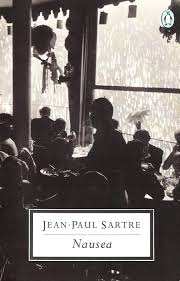
Nausea: A Personal Assessment


Nausea is a book that impressed me a lot. I class it as formative reading. In this brief post, I will not make arguments as such. Rather, I am going to write why this book had an emotional impact upon me when I read it. I am going more for a ‘cheesy op-ed’ vibe rather than a ‘scholarly’ one.

When I read Nausea, I had scarcely imbibed any philosophy. I have read a little more philosophy since. Hence, I did not have the remotest framework to understand the ‘philosophical thesis’ expounded by the text. ‘Thesis’ sounds problematic given that this is a novel, not a philosophical tract.

Apparently, this is the closest a work of fiction has come to being called ‘a philosophical novel,’ according to Iris Murdoch. Surely, a work of philosophy is more ‘holistic’ than fragmentary or plural. It offers a thesis. Nausea is more plural in that there are little tid-bits here and there of philosophising scattered around the text. Surely, a novel can be ‘philosophical’ in so far as it draws from philosophy, but it is not philosophical in that it doesn’t use the same methods. More often than not, a ‘philosophical novel’ brims with arguments, but it doesn’t offer a single thesis which is arrived at inductively. My idea of an exciting novel is one which is completely against the idea of having a thesis. My idea of an exciting novel is one which is ambiguous and anti-didactic. A novel that has any philosophy in it derives its material from philosophy and plays around with it. You can broach philosophical questions in a much more haphazard way. You don’t have to do it properly because the novel is a form without rules. Anyway, let’s get abstruse theory out of the way. Basically, at the time in which I read it, I did not fully extrapolate the existential argument propounded by the book.

Nausea is the kind of novel that appeals enormously to angsty teenagers. Why? Well, because, to state the obvious, teenagers feel alienated and angsty a lot of the time… When I read it, I felt as if I ‘saw’ my life mirrored, to use a crass metaphor, in that of Antonie Roquetin, the protagonist of the book.   

Roquetin completely detaches himself from others. He is a former academic and historian. He leads a subdued existence where he goes for walks across the sea front, writes in cafés and studies at his desk. The title ‘nausea’ refers to the way in which he can no longer derive any satisfaction, or even any feeling, from anything. In a very striking scene, he jabs his hand with a knife. It bleeds profusely, yet he is utterly passive about it. He goes to galleries and he is utterly unmoved by the paintings he sees. He detests music and calls people who go to concert halls ‘mugs.’ He no longer sees a former lover. Every now and then he experiences pangs of ‘nausea.’

Basically, when I read this novel I was also a recluse and terribly alienated. More than anything, over the years I have also felt immunised from ‘enjoying’ anything in the most elementary level. I am going to give a few anecdotal examples. I equate certain types of behaviour as being ‘childlike.’ I feel as though I am seeing the mind of children trapped within the body of adults. It is just adults having fun. When I go to clubs and I see people dancing, I see it as an utterly childlike expression. I feel the same bemused reaction when I see people take ‘selfies.’ It makes me think of them as being ingenuous. How can they go along with trends which seem so utterly artificial? Worse still, I feel as though time passes extremely quickly. While I am isolated in my room, everyone outside is busy having fun. I find their idea of fun utterly perplexing. The next thing I know, all the people I know are busy having children and getting married. Meanwhile, I am still in my room, utterly frustrated because I have not achieved the goals I have set for myself. Hence, I find the sense of alienation that Roquetin experiences, and his immunity to ‘satisfaction,’ very relatable.

I found this novel a far more relatable experience than Camus’ The Outsider. I think that’s down to the fact that Mersault is such a wooden and two-dimensional character. Mersault, although an intelligent and educated person, is perhaps so immunised that he cannot really even bring himself to articulate his sense of alienation. He reacts to his environment, ultimately, in a very primal way. The universe is absurd and there is no universal moral imperative, but Mersault merely reacts to this by murdering a group of people in a completely random way. Roqeutin, meanwhile, retreats into introspective despair. Psychologically, this makes for a much richer experience.

Ultimately, I am not entirely ‘mirrored’ by Roquetin. He is much more educated than I am. I am perhaps closer in spirit to the character ‘The Autodidact.’ When Roquetin meets The Autodidact, he finds him to be a sweet, and ultimately deluded, character. He has no real education, but he is determined to read as much as he can and build a belief system in the process. Roquetin looks down on The Autodidact, but still views him with some affection. He describes him as reading every volume in the library and, once that happens, he will ask himself ‘and now what?’ This goes completely against the grain of the vision that Jorge Luis Borges had in his story ‘The Library of Babel.’ In that story, all of the books ever written are held there. In addition to that, every single variation of an individual book is held there. Books containing gibberish are held in the library. Once one reads every single book, they reappear. Hence, Borges is saying that one can never attain complete knowledge, even if one were some sort of divine entity capable of reading the entire canon of human knowledge. Knowledge keeps growing. One’s perception of something is always open to re-evaluation. Sartre’s view seems a lot more pessimistic than Borges’. Perhaps one can never attain true knowledge, but even if one did – so what? Perhaps, what’s more important is to stake a political position and to gain experience.


Perhaps disappointingly, the novel ends in a clichéd way. Roquetin proclaims (I am paraphrasing here) ‘Oh, I will leave reclusion and my study area! Oh yes, I will become a writer – a novelist!’ This is somewhat similar to the ending of Joyce’s Portrait of the Artist, which is similarly sentimental. But then, Joyce is so creative with his use of language in those passages that it remains worthwhile. Anyway. Nausea is one of my favourite novels for a number of reasons and one of the most important books I read in my formative years.