I will now try the impossible - try to explain, in some kind of fluid and coherent prose, why Andrei Tarkovsky is my favourite director. Invariably, when I write these kind of appraisals, I cop-out with gushing superlatives. I am going to try as much as I can to remain objective and to put my finger as to why Tarkovsky means so much to me...
Tarkovsky's role in the Soviet Union was ambiguous. Whilst not overtly critical of the regime, it is clear that his films do not align themselves with the authorities. It is clear from a film like Andrei Rublev that, for Tarkovsky, the role of the 'artist' is to create, inquire and discuss in the face of oppression. The rigid atheism characteristic of the Soviet regime was also completely discrepant to what mattered mostly to Tarkovksy - spirituality and the need for the individual to reflect on his place in Earth. Tarkovsky's films look 'inside' rather than 'outside' and, in such political surroundings, it is a small miracle that his films were made.
The painter Andrei Rublev can only create within a society in a state of turmoil. Set in 15th century Russia, around the time the country became Tsarist, it is clear that Rublev is dependant on the carnage and exploitation surrounding him to unearth his mural paintings. Continuously brooding and rationalising everything, he turns to orthodox Christianity to give him some sort of moral compass and purpose. An invasion of the Tartars, which completely devastate and maim the community he has lived in, leads him toward a vow of silence. He devotedly keeps to his word, only until the construction and casting of a bell makes him review of his decision. This bell has been built with such scrupulous craftsmanship that he is awed. It becomes clear that the creation of art, in its most crafted and disciplined form, can lead to transcendence and resolution. When the bell clangs toward the end of the film, Rublev knows it and the audience knows it.
Another clear theme that runs through most of Tarkovsky's films is memory. It is an illusory concept, often leading to grief and misconceptions. This is beautifully explored in Mirror. The structure of the narrative generally pans out in accordance with the narrator's notions of past and present. Scenes transpire in relation to what the narrator is actually going through in his everyday waking life. His tormented issues with his mother, his estrangement from his son, the fractured relationship with his wife, dream recollections, etc. All these elements ebb and flow as he tries to make sense of his broken family relationships. The narrative is seldom linear because of the wavering nature of memory and human thought. I have seen the film three times now and each viewing is different and revelatory.
Having spoken of dream sequences above, I'll just make the small remark that they are the closest I've seen to real dreams in any representational art. Some people say that the surrealist visions of Dali, Bosch, Ernst etc. are dream-like, but to me they really aren't. The dreams in Tarkovsky's films often take place in enclosed spaces and scenes often shift from one place to the other. Natural elements - fire, water, snow, etc. - often feature. (In a scene in Solaris, the protagonist visits his father, gazing into the home from outside his window pane. It is raining within the house, rather than outside. This is a warped logic often characteristic of dreams.) He certainly is a director who manages somehow to pierce into your skull. Three or four months after seeing my first Tarkovsky film, Solaris, I had a series of dreams influenced by the film's atmosphere.
A tangential theme of interest is that of the characters' wishes and what exactly these wishes mean and involve. There is often something hazardous in the Tarkovsky film about striving after an impossible goal. In Solaris, the planet where the astronaut resides in, the nostalgia for his deceased wife leads to her resuscitation. They are impermeable to one another and the film constant reminds the viewer that his wife is unearthed because of his unstable mind. The possible radiation (it is unclear in the film if this is the case) that the planet emits destabilises and fractures the lucidity and rationality of his waking thought. Likewise, in the flabbergasting film Stalker, the three characters become crazed by the toxicity of 'The Zone'. It is a place capable of unearthing their innermost wishes, but the locality drives them toward insanity. In the end, they are few yards away from the room granting them their wish, but they are unable to walk in. This is not only because it might be too dangerous, they are unable to confront the inner demons and fears that reside within their quixotic and yearning minds.
Another reason why his films mean so much to me is the constant recurrence of nature. The scenes depicting wildlife, plains, fields, swamps, forests are irresistibly shot. Tarkovsky could be considered a modernist in the sense that his films can often be structurally elliptical and theatrically undramatic. However, he is a romanticist in the way he turns to nature for inspiration and the way the reflection of nature helps as individuals and our purpose in the world. Most modernist 20th century artists turned to urbanity and the hoopla of living in a high-octane community. Tarkovsky jettisons all that and returns to the object of fascination of Wordsworth and so many other 19th century artists - the immensity of nature and the reflectivity it provokes.
His characters are often populated by children. (Most notably with the child protagonist in Ivan's Childhood.) A scene that I recall is in Mirror when the protagonist's son leafs through a large book. It seems to invoke the feeling of raging curiosity and inquisitiveness. Children feature throughout Tarkovsky's film because they know less. As a result, they perceive situations and concepts far more vividly. Too much knowledge seems to be very perilous indeed to Tarkovksy - just look at what it leads The Writer, The Scientist and the Stalker toward in Stalker...
So, above I provided a few notes as to why Tarkovsky's films mean so much to me. These are themes that I personally connect with and inform my sense of purpose in the world...
Tuesday, 21 August 2012
Friday, 20 July 2012
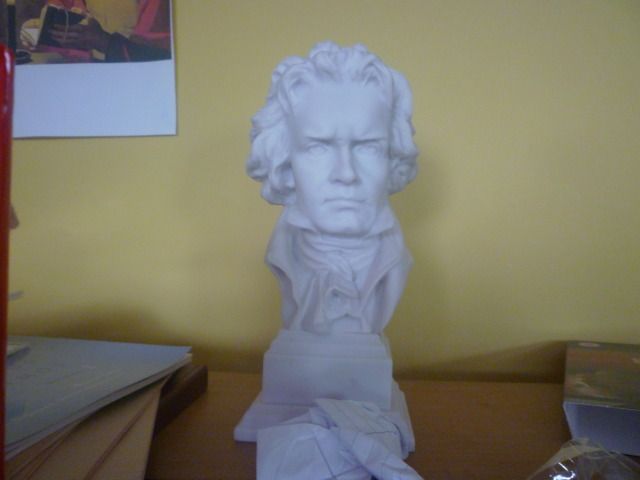
My Beethoven bust!
This is what I asked for my birthday and my swell parents agreed to pay for it. It finally arrived!
I might not be a composer of any sort, but this will be my daily reminder to create!
Wednesday, 18 July 2012
Writers at work
The physical experience of writing is something I like. When I'm writing a story I hit the keys with all my force. Sometimes people surrounding me in the library will ask me to keep it down. I sometimes also rock back and forth in my chair.
I'm not saying I'm anywhere near as good as the authors below - and never will be. But below are a few authors in the middle of the writing process.
J. G. Ballard
Paul Auster
Roberto Bolano
George Orwell
T. S. Eliot
John Updike
I'm not saying I'm anywhere near as good as the authors below - and never will be. But below are a few authors in the middle of the writing process.
J. G. Ballard
Paul Auster
Roberto Bolano
William Faulkner
T. S. Eliot
Sunday, 1 July 2012
The genius of Anton Webern
I've been hearing Anton Webern for years, but only recently have I come to appreciate the true value of his music.
The way these strands of sound are sown together fills me with awe. I also love how, though this music is mathematically calculated and tabulated, it sounds as if it has been extolled from a very brooding introspective mind.
Last time I went to Chile I attended programme including a Webern piece. An old lady sitting next to me said "I could have written that." If only you knew, old lady... If only you knew.
Saturday, 16 June 2012
Tuesday, 1 May 2012
Thoughts on free expression
In a pluralistic society, free expression and diversity of opinions should be optimised. The need to silence and repress these opinions is the hallmark of any totalitarian regime.
When Salman Rushdie's The Satanic Verses was published, a Fatwa was issued against him and he had to go into hiding for several years. While Rushdie is critical of the fascist Islamic groups in Islam, there was no intention of blaspheme in the book. Below is a video of Christopher Hitchens airing his opinions on the matter.
Still, I will go further, insensitivity should never be a valid reason to censor and silence supposedly bigoted opinions or novels. When a Catholic nun claims to be offended by Ken Russel's The Devils, or when a Muslim is aghast by a cartoon defacing his religious leader, why should they declare that that opinion must be silenced? Don't they, in turn, become bigoted?
The need to transgress is integral to any 'artist' and the need to provoke is vital for any columnist. In another Christopher Hitchens video I saw someone he debated claimed that (paraphrasing) "In an auditorium full of people, a member of the audience should never stand up and shout out FIRE!" Hitchens replies "you should not use such a bullshit example."
Indeed, the need to derail, disorientate and jostle people is, once more, absolutely vital. Don't forget that Galileo, despite the precision of his calculations, was shouting out FIRE. When society continues on the same single-minded course, provocation is essential for progress. By provocation, I don't just mean the simple need to shock, but the airing of remarkable discoveries. These discoveries are often contrary to a society that holds them in contempt, but they are able to lead us to become more aware of ourselves and, indeed, more pluralistic.
Whether it's Venezuela or Ecuador, where newspapers are shut down for criticising populist governments; or North Korea, a secretive totalitarian state that literally starves its people to death; or Syria, a country that kills its citizens for daring to believe in the idea of a democracy; or Iran, where the internet and other media outlets are constantly supervised... These are countries with grievous flaws that need to be criticised - and any attempt to do so should not be met with sadistic bullying...
When Salman Rushdie's The Satanic Verses was published, a Fatwa was issued against him and he had to go into hiding for several years. While Rushdie is critical of the fascist Islamic groups in Islam, there was no intention of blaspheme in the book. Below is a video of Christopher Hitchens airing his opinions on the matter.
Still, I will go further, insensitivity should never be a valid reason to censor and silence supposedly bigoted opinions or novels. When a Catholic nun claims to be offended by Ken Russel's The Devils, or when a Muslim is aghast by a cartoon defacing his religious leader, why should they declare that that opinion must be silenced? Don't they, in turn, become bigoted?
The need to transgress is integral to any 'artist' and the need to provoke is vital for any columnist. In another Christopher Hitchens video I saw someone he debated claimed that (paraphrasing) "In an auditorium full of people, a member of the audience should never stand up and shout out FIRE!" Hitchens replies "you should not use such a bullshit example."
Indeed, the need to derail, disorientate and jostle people is, once more, absolutely vital. Don't forget that Galileo, despite the precision of his calculations, was shouting out FIRE. When society continues on the same single-minded course, provocation is essential for progress. By provocation, I don't just mean the simple need to shock, but the airing of remarkable discoveries. These discoveries are often contrary to a society that holds them in contempt, but they are able to lead us to become more aware of ourselves and, indeed, more pluralistic.
Whether it's Venezuela or Ecuador, where newspapers are shut down for criticising populist governments; or North Korea, a secretive totalitarian state that literally starves its people to death; or Syria, a country that kills its citizens for daring to believe in the idea of a democracy; or Iran, where the internet and other media outlets are constantly supervised... These are countries with grievous flaws that need to be criticised - and any attempt to do so should not be met with sadistic bullying...
Though, of course, are all pluralistic countries really that better off? What's the difference between democracies and dictatorships? Are the citizens of Western Europe, U. S. A. and Japan really not just automatons? The media outlets and various kind of institutions often try to drug citizens with various kinds of sedatives - television programming, routine jobs, etc. - until they are immunised. Not that different from the kind of apocalyptic visions that Huxley had in Brave New World... And, in such a society, are journalists really able to express their opinions? Are people, like in Brave New World, labelled and compartmentalised by institutions and just sedated by various forms of entertainment?
Tuesday, 17 April 2012
Chile and United Kingdom, parallel countries
There are a few countries parallel to Chile. Tunisia, in Africa, is a good example. A literate, educated country with little equity and disparate wealth, divided and disproportionate.
Out of the big guns, the very European country I reside in, and the country I happen to be writing from right this minute, could be seen as a parallel country. Indeed, Chileans are said to be "the English from South America."
How did this expression come into being? Generally speaking, Chileans, while very warm and friendly, are far more moderate than their neighbours. Argentineans, notably, are all over your face. While Chileans are an open book, they aren't that effusive.
There's also the similar customs. Chileans have their little rituals, too - just as the English savour their tea, at 5 PM any traditional Chilean family will be seen eating once with a lot of tea, bread and marmalade.
The geography of each country also explains each country's idiosyncrasies. Both are remote and secluded - the United Kingdom is an isolated little island whilst Chile is separated by the Andes and faces the Pacific, not Atlantic, Ocean.
But the crux of the matter is the political system. Since the 1950s, the class divide has changed for the better in England; however, the political system is very much determined by class. Most ministers and members of parliament are from privileged backgrounds. A vote is likely to be determined by one's standing in class, too.
The political class in Chile is far more pronounced. The controversial rise in tuition fees from £3,000 to £9,000 by the ruling Conservative party in the UK was far more than an economical move - it was a way of privatising education.
Because education in Chile is privatised, it means that the differences in class are drastic. The lower classes have little chance of an education whilst the upper class controls politics and the media. There can be no shadow of doubt that most political persuasions in Chile are determined by class.
And just as the protests criticising these aforementioned inequalities were rife in Chile, many protests and riots broke out in England - some politically motivated, others not. Chile and United Kingdom are parallel countries and I'm a citizen of both.
Out of the big guns, the very European country I reside in, and the country I happen to be writing from right this minute, could be seen as a parallel country. Indeed, Chileans are said to be "the English from South America."
How did this expression come into being? Generally speaking, Chileans, while very warm and friendly, are far more moderate than their neighbours. Argentineans, notably, are all over your face. While Chileans are an open book, they aren't that effusive.
There's also the similar customs. Chileans have their little rituals, too - just as the English savour their tea, at 5 PM any traditional Chilean family will be seen eating once with a lot of tea, bread and marmalade.
The geography of each country also explains each country's idiosyncrasies. Both are remote and secluded - the United Kingdom is an isolated little island whilst Chile is separated by the Andes and faces the Pacific, not Atlantic, Ocean.
But the crux of the matter is the political system. Since the 1950s, the class divide has changed for the better in England; however, the political system is very much determined by class. Most ministers and members of parliament are from privileged backgrounds. A vote is likely to be determined by one's standing in class, too.
The political class in Chile is far more pronounced. The controversial rise in tuition fees from £3,000 to £9,000 by the ruling Conservative party in the UK was far more than an economical move - it was a way of privatising education.
Because education in Chile is privatised, it means that the differences in class are drastic. The lower classes have little chance of an education whilst the upper class controls politics and the media. There can be no shadow of doubt that most political persuasions in Chile are determined by class.
And just as the protests criticising these aforementioned inequalities were rife in Chile, many protests and riots broke out in England - some politically motivated, others not. Chile and United Kingdom are parallel countries and I'm a citizen of both.
Subscribe to:
Posts (Atom)