Wednesday, 23 December 2015

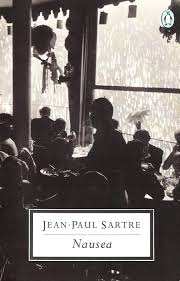
Nausea: A Personal Assessment


Nausea is a book that impressed me a lot. I class it as formative reading. In this brief post, I will not make arguments as such. Rather, I am going to write why this book had an emotional impact upon me when I read it. I am going more for a ‘cheesy op-ed’ vibe rather than a ‘scholarly’ one.

When I read Nausea, I had scarcely imbibed any philosophy. I have read a little more philosophy since. Hence, I did not have the remotest framework to understand the ‘philosophical thesis’ expounded by the text. ‘Thesis’ sounds problematic given that this is a novel, not a philosophical tract.

Apparently, this is the closest a work of fiction has come to being called ‘a philosophical novel,’ according to Iris Murdoch. Surely, a work of philosophy is more ‘holistic’ than fragmentary or plural. It offers a thesis. Nausea is more plural in that there are little tid-bits here and there of philosophising scattered around the text. Surely, a novel can be ‘philosophical’ in so far as it draws from philosophy, but it is not philosophical in that it doesn’t use the same methods. More often than not, a ‘philosophical novel’ brims with arguments, but it doesn’t offer a single thesis which is arrived at inductively. My idea of an exciting novel is one which is completely against the idea of having a thesis. My idea of an exciting novel is one which is ambiguous and anti-didactic. A novel that has any philosophy in it derives its material from philosophy and plays around with it. You can broach philosophical questions in a much more haphazard way. You don’t have to do it properly because the novel is a form without rules. Anyway, let’s get abstruse theory out of the way. Basically, at the time in which I read it, I did not fully extrapolate the existential argument propounded by the book.

Nausea is the kind of novel that appeals enormously to angsty teenagers. Why? Well, because, to state the obvious, teenagers feel alienated and angsty a lot of the time… When I read it, I felt as if I ‘saw’ my life mirrored, to use a crass metaphor, in that of Antonie Roquetin, the protagonist of the book.   

Roquetin completely detaches himself from others. He is a former academic and historian. He leads a subdued existence where he goes for walks across the sea front, writes in cafés and studies at his desk. The title ‘nausea’ refers to the way in which he can no longer derive any satisfaction, or even any feeling, from anything. In a very striking scene, he jabs his hand with a knife. It bleeds profusely, yet he is utterly passive about it. He goes to galleries and he is utterly unmoved by the paintings he sees. He detests music and calls people who go to concert halls ‘mugs.’ He no longer sees a former lover. Every now and then he experiences pangs of ‘nausea.’

Basically, when I read this novel I was also a recluse and terribly alienated. More than anything, over the years I have also felt immunised from ‘enjoying’ anything in the most elementary level. I am going to give a few anecdotal examples. I equate certain types of behaviour as being ‘childlike.’ I feel as though I am seeing the mind of children trapped within the body of adults. It is just adults having fun. When I go to clubs and I see people dancing, I see it as an utterly childlike expression. I feel the same bemused reaction when I see people take ‘selfies.’ It makes me think of them as being ingenuous. How can they go along with trends which seem so utterly artificial? Worse still, I feel as though time passes extremely quickly. While I am isolated in my room, everyone outside is busy having fun. I find their idea of fun utterly perplexing. The next thing I know, all the people I know are busy having children and getting married. Meanwhile, I am still in my room, utterly frustrated because I have not achieved the goals I have set for myself. Hence, I find the sense of alienation that Roquetin experiences, and his immunity to ‘satisfaction,’ very relatable.

I found this novel a far more relatable experience than Camus’ The Outsider. I think that’s down to the fact that Mersault is such a wooden and two-dimensional character. Mersault, although an intelligent and educated person, is perhaps so immunised that he cannot really even bring himself to articulate his sense of alienation. He reacts to his environment, ultimately, in a very primal way. The universe is absurd and there is no universal moral imperative, but Mersault merely reacts to this by murdering a group of people in a completely random way. Roqeutin, meanwhile, retreats into introspective despair. Psychologically, this makes for a much richer experience.

Ultimately, I am not entirely ‘mirrored’ by Roquetin. He is much more educated than I am. I am perhaps closer in spirit to the character ‘The Autodidact.’ When Roquetin meets The Autodidact, he finds him to be a sweet, and ultimately deluded, character. He has no real education, but he is determined to read as much as he can and build a belief system in the process. Roquetin looks down on The Autodidact, but still views him with some affection. He describes him as reading every volume in the library and, once that happens, he will ask himself ‘and now what?’ This goes completely against the grain of the vision that Jorge Luis Borges had in his story ‘The Library of Babel.’ In that story, all of the books ever written are held there. In addition to that, every single variation of an individual book is held there. Books containing gibberish are held in the library. Once one reads every single book, they reappear. Hence, Borges is saying that one can never attain complete knowledge, even if one were some sort of divine entity capable of reading the entire canon of human knowledge. Knowledge keeps growing. One’s perception of something is always open to re-evaluation. Sartre’s view seems a lot more pessimistic than Borges’. Perhaps one can never attain true knowledge, but even if one did – so what? Perhaps, what’s more important is to stake a political position and to gain experience.


Perhaps disappointingly, the novel ends in a clichéd way. Roquetin proclaims (I am paraphrasing here) ‘Oh, I will leave reclusion and my study area! Oh yes, I will become a writer – a novelist!’ This is somewhat similar to the ending of Joyce’s Portrait of the Artist, which is similarly sentimental. But then, Joyce is so creative with his use of language in those passages that it remains worthwhile. Anyway. Nausea is one of my favourite novels for a number of reasons and one of the most important books I read in my formative years.

Thursday, 12 November 2015

Notes for a novel

It is set in a world in the future (or non-future). It could well even be a parallel reality. This is left unclear.

The human body and the human mind are seen as means to an end, not as ends in themselves. Men objectify the female body and women objectify the male body. The body is just used for procreation and for sexual gratification. The mind is used to propagate ideas about natural science, philosophy, maths, general theorising, moralising and creative endeavours. The mind is used, generally, for ‘pure’ ideas. Even creative endeavours are generally seen as a systematic endeavour, not as ‘expression’. Novels, for example, aim to approach problems - societal, theoretical, philosophical, moral, etc. - and solve them.

The intellect and sex, once seen as polar opposites, are seen as integral in this society. Sex is often referred to as ‘dialectic copulation.’ Argument is seen as the interchange and debate of ideas. Sex, meanwhile, is seen as an interchange of energy.

Concepts like ‘love,’ ‘empathy,’ and ‘affection’ are seen as hokey and outmoded. There are no relationships, or even friendships. The nuclear family does not exist. New-born infants, who are invariably created by accident, are reared in blocs. They are given basic training in language and arithmetic. After they hit a certain age, they shown certain books and told to pursue their main interests.

The economy works in different ways. There is a total end to commodity fetishisation. The love of objects is, again, seen as ‘hokey’ and ‘outmoded.’ Books and music albums are completely stripped of any kind of marketing appeal. They have no covers. This means that the person purchasing albums and books engage with the ideas on a ‘pure’ level. They don’t fetishise the packaging. The kind of cultural posturing associated with global capitalism - i.e. behaving and dressing in certain ways because you have certain cultural tastes - is put to an end. One simply listens to music or reads certain books because one has an interest in the ideas that they propagate. All cars look the same. All computers look the same. Clothes largely look the same. Etc. Most sectors of the economy - and all unskilled labour - are completed by robots. The society is a mixed economy, though private enterprise is heavily regulated. This does not stress anyone, as there is hardly any entrepreneurial incentive anywhere. There is no real ‘competition’ anywhere. Selling one’s body for sex is seen as a healthy and noble practice, not as something illicit. Sexual promiscuity, and the financial transaction of sexual promiscuity, is encouraged.

Parliamentary politics, meanwhile, is much closer to the Athenian model. There are no ‘politicians’ as such. People go in and out of parliament and determine policy. The discussion is more theoretical than practical. There is no partisanship. Parliament is more like a giant seminar room.

The society is founded on the assumption that human beings can overcome any supposed limitations. Hobbes’ ‘Leviathan’ is taught and is seen as being wrong on every front. As this is not a demagogic or fascistic society, Hobbes is not ridiculed or bedevilled. He is simply seen as a great thinker who did not get things right. Humans are autonomous agents. Although the society is collective, it is also very libertarian. Humans have a great deal of freedom. There is no ‘social contract.’ Although people are, to a degree, limited and flawed, they are constantly pushing themselves to achieve new goals. Meanwhile, society is also collective in the sense that wealth is distributed equally, there is no competition and people constantly meet each other and engage in seminar discussions.

The novel sees all this as utopian, not dystopian. 

Thursday, 5 November 2015

Ambivalence


How sure are you of what you preach? Even as I make this grand pronouncement, I feel ambivalent. Maybe I am sure of what I preach. Then again, I may have doubts.

Now what’s wrong with that? If you think about it carefully, you’ll find that we are all thoroughly ambivalent. There is always a tinge of doubt in anything you say. Your professor is ambivalent when he claims (I am going for a somewhat generic example) that the French Revolution means this. Your girlfriend/boyfriend might be ambivalent when she/he says I love you. What is love? Am I sure what love means? Your partner must surely 1) feel besotted by other people every now and then and 2) get the hots for other people. But then, how do we distinguish love from lust and love from infatuation? Every time you try to arrive at a position, you become embroiled in maddening semantics.

So this makes me a sceptic. Good, then. We should really revive the type of scepticism practiced by the Ancient Greeks, not the scientific community. I can, say, go to Canterbury cathedral, have a lovely experience and admire the sacredness of it all. I can go to a scientific conference and agree that science is useful in some regards. That still doesn’t mean that 1) I believe in God or that 2) I believe that science is the most enlightened field of study. I can look into these two fields, absorb what I like from them and emerge with a wholly wishy-washy synthesis. This is true scepticism. When a lot of scientific thinkers claim that they are sceptics, they are being completely disingenuous. How can they claim to doubt everything and often make ludicrous assertions claiming (for instance) that science can solve anything, we need to follow science to have an enlightened society, etc.?

But we want absolutes; we don’t want callow relativism! Still, my ambivalent tendency would ascertain that some things are absolute and others are relative. That in itself is (callow?) relativism! There is a type of intransigent relativism peddled by thinkers foisted upon frustrated undergrads/postgrads the world over. (I have in mind the Holy Trinity of French post-modernism: Foucault, Derrida and Deleuze.) If you were to claim that everything is relative, that in itself is a absolutist statement! Surely, if you were truly ambivalent, you’d say – look at I’m not sure, I think that morality is absolute but knowledge is relative. This stuff over yes, the other stuff over there no.

Ultimately, we are all ambivalent about everything. The real reason we say we aren’t is down to politics. It’s that simple. When it comes to party politics, I for example might be a synthesis of a conservative, a socialist and a liberal but I will support party X because I believe that it will have positive outcomes (a practical conclusion) or that they may match my own political beliefs (a more theoretical one). If I am an academic, I might assert that knowledge is relative despite having many reservations. If I suppress these reservations, politically I will rise in the echelons of academia. As an academic making claims to be a relativist, the more absolutist I am about my relativism the more I will prosper. If we act in certain ways, concretely define why we support X policy, we become less ‘embroiled in all these maddening semantic definitions.’ We also present a clear and cogent debate, although we repeatedly have reservations about our arguments.

If this weren’t the case, how come do people change their political affiliation all of a sudden? How is it possible to have a complete 180 degree turn? Are you really capable of believing stolidly in Marx and then being a fervid believed of ‘neo-liberalism’ the next? All thanks to an epiphany? Surely, as a Marxist, one would have seen elements of truth in a certain amount of market freedom and entrepreneurialism. (I think that most people feel happy for someone when they open their own niche business and make a living off it.) Upon becoming a right-wing ideologue, you might see elements of truth in Marx’s analysis of capitalism. You might recognise that widening inequality isn’t good and that some measures, albeit non-Marxist ones, must be taken to curb it. A statement of a political affiliation is largely a pose, albeit a useful one. As stated above, it contributes to a cause and it can be helpful in offering the most clearest possible label for your type of thinking. This is even the case if you claim to see the world in black and white terms. You might claim to believe that 1) capitalism is rotten to the core and we must foster a class war to overthrow it, or 2) if we let the upper crust get as rich as possible that wealth will trickle down without any kind of state intervention. But, even if you claim to think in these binary terms, you will realise that, upon introspection, there are a lot of shade of grey in your thinking. Tell all that to an ideologue.

Complexity


I like complexity. I like complexity for its own sake. I am not altogether sure why I developed this curious predilection. This might entail a fascination for hard subjects like maths and science. As it happens, I do not have an aptitude for mathematics. Actually, I am pathologically stupid at maths. I am sure that if I did have a knack for it that I would have pursued it. I would probably spend all day racking my brain over labyrinthine equations. When it comes to science I find that I have a disturbing apathy towards natural phenomena. I read something written by David Berlinski recently. Please, for the love of God, don’t look the guy up. You’d be wasting your time. The man is a poseur and a wind-bag, albeit an entertaining one. Anyway, this little bit of writing sadly resonated with me: ‘I have never been particularly eager to know how it is that the universe was formed, or how a magnet works, or why, for that matter, water flows downhill. … There it is—a certain implacable lack of physical curiosity.’ (Unlike Berlinski, I am interested to how the universe was formed, but that’s down to ‘teleological’ arguments about philosophy than any interest in nitty-gritty science…)

I had an amusing and interesting experience recently. I was about to call it epiphanic, but I won’t get ahead of myself. I went to a celebration of Chile’s independence (18th of September). I ran into a computer science student. In these situations – in gatherings – one of the following outcomes will transpire: 1) I will stand awkwardly in a corner of the room, or 2) I will strike a conversation with the nerdiest boy in the room. So, in this particular gathering, I ended up the entire night speaking to the nerdiest boy in the room. We prattled at each other about political theory, philosophy and other tangential topics.

At one point, I looked at young children playing. I wistfully said something like, ‘I was once like that – completely carefree, childlike, spontaneous.’ He was visibly annoyed by what I said. He beamed back with ‘Stop talking about thing as if they were transient!’ As is my wont – I swear to God that I do it naturally, not to show-off – I did a bit of arcane name-dropping. I mentioned Heraclitus. (Yeah, right! Mentioning a name like that in a conversation is really natural!) I said that, for Heraclitus, a guy who lived 500 years before Christ, everything changed constantly, but that there was an underlying order governed by reason. He replied with, ‘For you, everything is the meta of the meta of the meta.’

He is right. Which leads me to the following. I like to look for underlying complexity. Surely science looks for underlying complexity, right? I look for it in topics in the humanities. I get excited by classical and jazz music where a lot of musical activity transpires simultaneously. (Organised by quite a mathematical structure. My mathematical ineptitude is probably why I never became a composer, an early dream.)  I get excited by arty and ambiguous films which are open to endless scrutiny. I get excited by huge, sprawling, digressive novels. My ambition is to write such novels. I am writing one right now. I like to read – and write – dense complex books for fun.

It has become clear to me that I am a tad too over-ambitious. I become attracted to complex subjects with little in the way of introduction. As an undergrad lit student, I always went for complex interpretations of texts. Although I graduated with a first, my lecturers must have sensed when reading my essays that I was getting ahead of myself most the time. These trained scholars, must have seen my essays as confused, hyperlexic and over-ambitious.

So I look for complexity in the ‘meta of the meta of the meta,’ not in empirical data or anything like that. It might mean that I have a scattered brain or that I am crack-pot. It might even mean that I am interested in pseudo-complexity! I see it like this: immerse yourself in the sea of complexity in a dense symphony, a novel, a film or a philosophical tract and you may emerge confused, enlightened or you simply be a richer person. Constructing something similar – i.e. a complex novel – is even more enlightening, confusing and enriching. So there you have it. This why I like complexity for complexity’s sake.

Wednesday, 14 October 2015

Impressive recent reads #3

The World as Will and Representation by Arthur Schopenhauer


Reading this tome was a mammoth undertaking that took me the best part of a year. Although Schopenhauer is renowned for being overwhelmingly pessimistic, I found his view of the world, to a degree, to be life-affirming.

The basic crux of his argument is as follows.To an extent, Schopenhauer agreed with Kant's distinction between the phenomenon (subjective perception, 'appearance') and the thing-in-itself. The thing-in-itself is external reality and, so Kant said, unknowable. We cannot know the thing-in-itself because we are limited to our own experience and our own subjective perception. Space, time and causality, for both philosophers, are 'a priori.' We have a predetermined understanding of them. We do not need to acquire knowledge to perceive any of these categories. As regards causality, even small children and animals already, for instance, know that they should not jump off a table. Schopenhauer argued that there is a underlying energy that powers all subjects and objects. It powers the whole of nature. It resides within 'the thing-in-itself' and it resides within ourselves. There is a pantheistic bent to this, though Schopenhauer is an atheist and sees nothing divine to it. This is what he called the 'will.' It is often characterised as 'striving,' which is instructive. The will seeks satisfaction, but it is constantly denied. The subject is constantly dissatisfied. The whole of nature is in a constant war of attrition. It 'wills' and it 'strives', but it is unsatisfied.

Schopenhauer divides the work into four parts. In the first, he examines epistemic questions ('The World as Appearance, First Aspect'). He concurs with Kant that time and space are a priori. An innate understanding of space, time and causality endows us with 'sufficient reason' (as in rational mental faculties) to process phenomena with no prior experience. All physical phenomena also needs a 'sufficient reason' for it to occur (i.e. the necessary causal relations and whatever intrinsic substantive qualities). In this section, he examines physical science to explain the perception of reality and to ascertain how we know what we know. Ever the systemiser, he uses logic to explain how the mind perceives certain objects and words and how it retains some objects and words to the detriment of others.

In the second section, he explores ontology ('The World as Will, First Aspect'). Here he explores the way in which 'the will' runs through everything. As it runs through ourselves, this means that both subjectivity and objectivity are interchangeable both in terms of perception and causality. Schopenhauer reveals his characteristic pessimism when he reveals that willing is a unsatisfactory, even painful, process. The whole of nature is willing and regenerating itself, with little purpose other than procreation (and misery!).

In the third section, Schopenhauer explores aesthetics ('The World as Appearance, Second Aspect.') This part is particularly enjoyable. Art, for Schopenhauer, represent 'Platonic Ideas.' By this he means that it expresses universal truths that are outside reality. It is outside space and time and outside a casual nexus. He explores all of the arts and ranks them in order of importance. Music is the 'purest' form of art. By this he means that it is informed by pure mathetmatics and doesn't have a shred of language or reference to the natural world. Essentially, art lets us see appearance in a way that is more subjective and removed from the every-day.

In the final section, he explores ethics ('The World as Will, Second Aspect'). Since we are all willing and eager to satisfy our own dreams, this implies that we are all selfish and amoral and do not care about the need for others. Here Schopnehauer specifies that we need to be compassionate. When we do this, we are 'denying' our will. Finally, Schopenhauer considers asceticism to be the 'highest' form of existence. By taking on poverty and not caving in to bodily desires, the individual 'denies' the will and takes control of his own volition. It is also a higher form of existence than art, since the former is a fleeting pleasure (and only a fleeting 'denier' of the will) and does not lead to an ethical lifestyle.

Schopenhauer is not a big a name as he was in the early 20th century, where he was generally a favourite of artists rather than philosophers. I find this a bit surprising in that a lot of his ideas are proto-Freudian and proto-Darwinian and they shape the discourses we have today. (As a whole, we are not that big on metaphysics or idealism any more, though. Those who are don't tend to be atheists.) His ideas on desire definitely foreshadow Freud. Despite Freud's dissection of sex, he was still overly moralistic and aimed to curb overpowering desire. He built 'psychoanalysis,' instead of celebrating asceticism. His ideas definitely foreshadow Darwin. The idea of the whole of nature 'willing' and striving for procreation has obvious parallels with natural selection. Admittedly, these ideas were gaining traction in Germany at the time. This is why Darwin was accepted far more swifyly than in the UK. This did have nasty implications, obviously, as it led to Social Darwinism and, ultimately, to Nazism.

There is a very interesting appendix where he offers several counter-arguments to Kant. Kant had an argument about a series of causes, with no beginning or end, which stretch back and forth into infinity. This would be the case if a human mind had no knowledge of causality. I can't remember Schopenhauer's objection to this, but I find the original argument fascinating. One of the central arguments here is that it is the intellect which mediates the perception of reality. This is instead of the mind simply perceiving reality and the intellect henceforth categorising it into an abstract concept. We actually use abstract concepts to make sense of objects.

I find philosophy to be at its most fascinating when the author systematises all of his beliefs. It feels as though he is trying to make sense out of everything he has ever perceived and read about. (In Schopenhauer's case, it did. He wrote this volume age 25, made small modifications before he died and wrote volume 2 during this period as well.) I like it when a author develops the idea, views it from different angles and questions the central idea's logic and cogency. I have grown to like this rigour, although it's certainly a lot more taxing to read than fiction or other non-fiction books. This book is still more readable, I am told, than stuff like Kant and Hegel, both of which I hope to approach one day.

The reason why I find the book life-affirming is that, for all of the pessimism, it's largely true. And, for all of the hopelessness, it's somewhat hopeful. If I have some sort of lofty ambition, I won't be able to realise it because there are other competing subjects and objects operating in a causal chain with their own lofty goals. Schopenhauer's individualism claims that we can attenuate this through art which is divorced from reality and, in more extreme cases, through denying our own desires. If we follow the latter route, we surely henceforth become more moralistic and compassionate. This is an account of the world which emphasises idealism (i.e. that pereption is generated thanks to thought rather than matter) whilst also recognising the reality of the physical world, the reality of our ontological selves (i.e. we are largely greedy and bent on personal gain) and the need to attenuate this through beauty (art) and compassion.

Invisible Man by Ralph Ellison


I liked Ralph Ellison's Invisible Man because it is a book about racial politics and identity that doesn't lapse into preachy didacticism. The central character has ambitions to learn and write. Despite his erudition, he is thrown out of university for a minor incident. He is told that he is meant to be subservient, that he shouldn't be proud nor even have a personality. This is so simply because the lead character is black.

Once more, this is a book that celebrates individualism. The character joins a white Trotskyite group campaigning for racial equality. The protesters claim to use 'scientific' language (the Soviets did claim that dialectic materialism was a science). Enlisted for his brilliant oratorical skills, he finds himself at odds with them despite his ability to communicate effectively with the black community. He finds their collectivisation disingenuous. They are members within a collective and go under aliases. He finds that this goes against desires to affirm himself as an individual. He also finds that they have no understanding, nor even any genuine empathy, for the black community.

More than anything, I found that you do not need to be from a racial minority to connect with this book. This book will resonate with anyone who feels alienated and detached from others. Ellison writes wonderfully and there are some lovely Biblical speeches.

Los Siete Locos/Los Lanzallamas by Roberto Arlt


Arlt really isn't a good writer. The metaphors are clunky, he writes prolix sentences and the prose is completely flat. There is a sense in these books that he is simply writing as fast as possible to get the book down on paper. He says as much in the introduction.

I think that people do overstate all of the existentialist stuff when writing about these books. There's plenty of death-of-God-gloom here and it does predate Sartre. What mainly excites me about this book is the socio-economic context. The characters are all poor and have megalomaniacal intellectual schemes. They want to create a utopian socialist utopian ruled by Christianity. They want to finance it by finding a pot of gold in the Andes and by owning all of the brothels in Buneos Aires! All of the characters are eccentric (or 'locos') and have their own revolutionary intellectual pursuits. This is really grimy stuff. Afflicted characters, prostitutes, madmen - this is Dostoyevsky in the streets of Buenos Aires!

The Trial of Socrates by I. F. Stone


This book is a little odd. It is a ad-hominem indictment of Socrates, a figure who we only know about through second-hand sources. The author is a political journalist, not a historian.

Athens was the birthplace of democracy. Socrates was an anti-democrat. He was a metaphysical orator who did not partake in politics. He was a complete crank. However, he did teach figures like Critias who went on to found the League of Thirty who mounted a coup against Athens. When democracy was restored, Socrates was brought to trial. Stone argues that, whilst Athens was not correct in trialing Socrates and sentencing him to a death penalty, Socrates did not do himself any favours. Athens was a democratic society and extolled free speech. Socrates was anti-democratic and his beliefs were an affront to its democratic values.

What I found surprising when reading the book is that I found absolutely no ideological core to the political belief systems of Plato/Socrates. They want society to be led by someone 'who knows.' There is very little more to this beyond 'the meek must be led by the strong' kind of stuff. Meanwhile, all of our judicial systems and parliamentary politics are indebted to the Greeks. Theirs was even more advanced in that it was more participatory and direct. Democracy was a nascent idea which was already largely well-formed. Whilst Stone constantly invokes Stalin and Hitler, at least they turned to horrible justifications and appropriated thinkers to build a thought system which were incoherent.  

The problem I found with this books is that Stone constantly looks at events in antiquity from the bias of 20th century attitudes and values. Socrates and other thinkers are judged by our standards. Worse, he invokes recent despots instead of placing these thinkers more closely within the context of their times. Also, from what I gather Socrates is more well-known for his moralistic teaching and for his metaphysics than for his politics (as Stone writes, he largely abstained from politics). Still, the book is written with flair and it was fun to read.

Monday, 28 September 2015

Why is experimentation dated?

It is tempting in clichéd journalistic parlance to write off experimentation as dated. Its apex was the 1960s and it stubbornly persisted in some quarters in the 1970s. It is seen as a naive and juvenile enterprise. It has little substance. It is nothing more than a cold intellectual exercise in formalism.

A term dished when defining experimentation is 'avant-garde.' The meaning of the word is to radically break conventions and staid practices. In a uber-ironic post-modern art-world that can seem a little trite. The word is, in fact, a little trite. What is the point in breaking all rules when the rules have largely been broken? What's the point in offending pieties when we live in such a liberally permissive society where no-one is ever shocked anymore? Everything about the term is clichéd. The desire to destroy the past and to insult a conservative agenda is in itself conventional - and boring. Shock in and of itself, with no accompanying form or content, is vacuous and childish.

The commercial art world is laughable in this sense. It has institutionalised the avant-garde. It is now respectable to break taboos in a badly framed photographed or an inchoate painting. Many people flock to the Tate to see works by Emin and Hirst. Their work embodies the avant-garde in the way I outlined it in the paragraph above. Both Emin and Hirst mount gratuitous art objects and installations. Or photographs. Or sometimes paintings. Whatever it is they do, their output is the same. It aims to slap the viewer in the face. The viewer is unruffled as he is used to being smacked constantly by other media. The motive, though, is laudable. There is a need, it seems, to institutionalise the edgy and the offensive.

What would the avant-garde of the 1920s, 30s etc. have said about this? No doubt, they would have been horrified. Theirs was largely a clandestine operation. They were effectively terrorists, launching bombs at a po-faced art establishment. The art world, and the avant-gardism it celebrates, now is the establishment. What's more, the avant-garde in the early 20th century was, apart from the shock value, interested in just making something interesting and worthwhile. Most of the artists were poor. It was generally made because the artist felt a desire to make it. Now the avant-garde in the art world can be often be the equivalent of becoming a banker in the financial sector. You can make pots of money. Most importantly, you have to be an astute entrepeneur. You have to know how to sell your specious object.

This is a shame. The desire to experiment, regardless of its putative claims to shock or innovate, is written off altogether. Experimentation is consigned to a by-gone era in cultural history. Why is this? The commercial art world is in a bubble of its own. It is a financial sector, not really a cultural one. Experimentation in film, music and literature is often written off now.

I remember reading an obituary somewhere of the Hungarian composer Gyorgy Ligeti. It said that his career started with a bang. His music had an audience. It was trendy. Ligeti kept composing arcane pieces nobody cared about. The obituary (I never think an obituary should pass judgement on its subject in this manner, but nevermind) said something like 'The world had moved on and he hadn't.'

I find it distressing how so many people are reluctant to see modern classical music as a continuation of their Romantic forefathers. It is seen by many as an anachronistic 1950s fad. People have moved on from it.

Although post-war composers like Boulez and Stockhousen used the rhetoric of the avant-garde, their music can be seen as an addition to the canon, not an act of destruction. Boulez did heckle at supposedly passé Stravisnky concerts and did assert that the 'Mona Lisa was dead.' He largely moved on from that. Stockhausen, meanwhile, retreated into obscure reclusion. Anyway, both composers added new ideas and new ways of thinking. Their work isn't empty nor gimmicky. (Someone like John Cage might be.) On the contrary, the opposite is true. When you first hear a piece by either composer, there is a sense of sonic overload. It is packed with ideas. When you hear it for the first time, you are overwhelmed. That's part of the attraction. You hear the pieces again and again and you start to hear structures and arrangements. You wouldn't be able to understand all of it. To do that, you would have to have deep understanding of music theory and maybe have some mathematical nous. That's also part of the attraction. They're densely layered works you will never fully understand. They're not cold. They're often energysing and visceral. I find that my mind in particular is exhilarated in the intriacy behind the construction, the aggressive force with which it is played and the strange angular beauty of the voices. It's a shame that it's increasingly uncommon to place, say, a piece by Elliott Carter next to one by Bach. Both are great, so why not?

The literary novel is said to be a dying breed. I hardly think that's true. There is a lot of respectability surrounding people like Jonathan Franzen and there is quite a big market for it. The greatest attraction for literary writing is to have a very individualistic voice and world-view. Increasingly, creative writing courses spew out impeccable writers who are not particularly individualistic nor do they write with a philosophy. If they write a post-modern novel or poem, it feels like a class assignment. Avant-garde poetry and literature has always felt to me like an externalisation of your mind into something scattered. There is a formula behind that now. How could you possibly formulate that? I sense that when I see avant-garde poetry here and there.

I feel that there is less of a need now for ambitious novel of ideas. Publishers are scared. They lose money if they push for something with ambition. The current state of the world is open to myriad analysis and insights. The effective media like these have on our minds is unprecedented. Why can't we have more novels analysing all this? I am aware that there are many. The problem is that they do not seem to have as much grip on the reading classes as the work of, say, Pynchon did in the 1970s.

I'll end with a few words about film. You could say that the golden era was the 1970s. Financial backers were willing to take risks on 'auteurs' with ambitious projects. That kind of complete control is less common today. Woody Allen, Terrence Malick and Martin Scorcese are one of the few remaining directors from that generation. Many arty films hardly ever profit, so why pump money into them whilst trusting some crazy guy? The arthouse market is fragmented. That, in a sense, is a good thing. There is so much to see and there are a lot of great young filmmakers around. It's just tough to find them - unless they get the help of a distributor.

It is easy to make the assumption that art films are a relic of the 60s. Or that contemporary classical music is cold and intellectual. Or that an experimental novel cannot be compulsively readable. We do have a certain advantage over the cultural era of the 50s, 60s and 70s. Although silly chicness is present now, it does not necessarily mean that it taints the perspective of the artist. Many films from the 1960s no longer get made - and with good reason. The desire for experimentation can be seen as a far more modest one. Instead of breaking taboos and upsetting older generations, it can be seen as a way of exploring interesting ideas in a more unorthodox and idiosyncratic manner. Why should that be dated? Isn't it an impulse shared by many people who aren't even artists?

Friday, 11 September 2015

Just be promiscuous with me!


I recorded this way over four years ago, aged 20. The worse thing is that hardly little has changed. I was very much right to be so anxious and gloomy about my future prospects regarding girls. This is worth hearing for a few laughs - it's so pathetic it's funny. I don't think I'll ever change!