Sunday, 22 September 2013

Thoughts on Terrence Malick

If one thought that all art had spent itself, that no-one made ambitious statements anymore, one only need take a cursory glance at the films of Terrence Malick. His films are imbued with allusiveness, beauty, ambition and technical mastery. Most of his films are of an emphatically grandiose ambition. He is certainly among my favourite directors and many others would concur that he is one of the very best alive. He has made just six films in the last forty-two years. He is a recluse, never grants interviews and steers clear from the public eye. His background initially was in academia, abandoning an Oxford PHD thesis on Heidegger to pursue a career in film.

There are parallels with Stanley Kubrick. Like Kubrick, Malick has a European technique coupled by an American sensibility and his films deal with deeply American subject matter. The cross-cutting, the dynamic camera work and tracking shots that characterise his films stand alongside far more comfortably with European cinema than American. Thematically, it is purely American and culled directly from its folklore. In many ways, he is the American equivalent to Andrei Tarkovsky or Robert Bresson. He creates films about spiritual transcendence coloured by the American landscape.

His first film, Badlands, was shot on a shoe-string budget and starred Martin Sheen and Sissy Spacek. It was based on a real event in the 1950s, where two adolescent lovers went on a killing spree after the young male killed his partner's father on a random act of impulse. They are both recalcitrant, almost psychotic youngsters who become embroiled in a murderous trek through the terrains of South Dakota. The simple narrative follows them travailing through these dry terrains, beautiful landscapes and Sheen's eventual death penalty.

The film is ravishing because of two reasons: its beautiful shots of landscapes and minor details, which enrich the film enormously, and the dialogue and relationships between the characters. It had a dramatic arc which would diffuse in Malick's subsequent films. The dialogue is pithy and sometimes becomes incongruously comic. They are both simple people from humble backgrounds and hardly stop to think about the moral implications of their actions. The film is narrated by Spacek's character in flowery, occasionally deadpan, prose. Malick's incredible camera work shines through especially well in a scene where both Sheen and Spacek contemplate the moon in a star-laden horizon. Many of these shots were not scripted and Malick captured them with both intuition and mastery.


Badlands, 1971

Seven years later came Days of Heaven, which was shot over an arduous period of two years. It takes place in American plains and Malick and his crew patiently waited for dusk to shoot astonishing takes of flames and saturated, orange-hued horizons. Malick only shot the film in early morning and early evening and Malick patiently observed the surroundings to capture the right takes. In terms of cinematography, it manages to surpass his debut. There is a startling scene of a herd locusts rising in the sky, shot with meticulous detail and bravura.

The drama, as a whole, is nothing special. Set during the depression, it follows a love triangle between a couple who pretend to be brother and sister to ingratiate themselves with the owner of the ranch. The owner takes a liking to the girl and they marry, resulting in a turbulent relationship between all parties. The narrative is a mere backdrop to the astonishing visuals on display. 

This film once more demonstrates Malick's gift of finding beauty in minutia. Mundane acts, such as eating or brushing one's hair, are shot with such lyricism that they acquire a further layer of beauty. Many things we take for granted in our daily lives - landscapes, routine - are remonstrated as something far more meaningful.


Days of Heaven, 1978

Twenty years would pass until his next feature, which I would consider to be his best, The Thin Red Line. It featured a star studded cast led by Sean Penn. Following this film, Malick's work became more elliptical. Now his films consisted of an unceasing montage of image and sound. It is a second world war film, following the treacherous battle of American troops against the Japanese in the South Pacific. 

It is a very literary film, following multiple perspectives and interior thoughts. It is very dynamic both because of its multiple perspectives and because of the beautiful, swaying camera which veers and rotates around these wrenching battles. The perspective alternates between the soldiers, who see the battles with anxiety; the natives, who feel intruded upon; and the army officers who have an implacable thirst for battle. Like Kubrick's Paths of Glory, Malick sees these kinds of military ventures as immoral and as needless loss of life. The film hardly results in easy viewing, the level of bloodshed being stratospheric, but the dynamic way in which Malick approaches the material transcends the viewer in a way few such war films do. It came out around the same time as Saving Private Ryan and identified itself as its more intelligent art-house cousin.

Now drama and narrative flair became of little importance to Malick. The images were now accompanied by cryptic poetic epigrams. Cinematography and narrative now became dislocated. The montage of visuals stretched for long periods, with apparent disregard for narrative or character development.
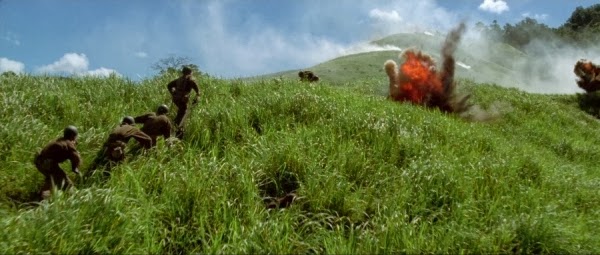

The Thin Red Line, 1998

Following The Thin Red Line, certain people thought that Malick had become self-parodical, a cheap imitation of his former glories. This was the criticism some leveled at The New World (which I haven't seen). It was also what some people said about the otherwise acclaimed The Tree of Life. This was his most ambitious film to date, attempting to scale heights few people dare aspire towards. It followed the origins of the cosmos in counterpoint to the family life of a Christian family (drawn from Malick's own childhood). Malick shoots hours and hours of footage and what we see is the cream of it. The epigrams which featured in The Thin Red Line reappear, this time voicing Christian reverence and belief. These can often sound platitudinous at times and I am sure swathes of people dismissed the film as high-minded humorless nonsense. Whatever its failures, its technical brilliance is a true sight to behold.

To the Wonder came only a year or so later. It featured the more cringe-inducing aspects of Tree of Life and, for the first time in Malick's career, its release fell to an indifferent silence. I saw it at a cinema and I was agog by it. (By all means, if you ever get to see a Malick film in a cinema, do so.) The shots of cathedrals, coasts, meadows are sumptuous to see in the big screen. Semantically, the film says pretty trite things about 'love'.

For all these later releases, Malick shoots hours and hours of footage. When it comes to editing, he leaves huge star actors out of the film. (Many have since stated that they will never work with him again.) Although Malick works with star actors, I see him approaching them the same way Bresson approached his 'models.' He does not use them as actors, he uses them as mere bodies to be framed within his visual paintings.

So, is all that he does now is navel-gazing? I think not. Malick is a master, who makes spiritual films that reconfigure the quotidian into great beauty. Let's thank our lucky stars he is around.  

Monday, 16 September 2013

Musical despots

An author imprints his ideas and personality onto the text. These are channeled directly to the final work. Although a copy editor may make minor modifications, the central thrust of his creative vision is entirely his own. A composer, similarly, crafts every detail and nuance of a musical piece. The final score is his, however radically an ensemble may choose to perform it.

Collaborative projects, generally, do not interest me as much. I generally find it more interesting when an individual takes over the collective and shapes it according to his artistic vision.

Many such ventures start democratically. Soon enough, however, the fledgling dictator mounts a coup de etat and becomes the leading musical director. Captain Beefheart & His Magic band started with all members on equal terms. Soon enough, Beefheart fired his band and acquired an impressionable crop of younger musicians who would do whatever he wanted (they would also be less resistant to the idea of playing 'weird' music, instead of the blues standards the first Magic Band were keener to perform).  The Fall also had a similar development. (The young roadies who handled the first group's equipment soon found themselves on stage performing the music.)

The leading despot often tries to manufacture the oddest stage act. One of the most striking examples is that of the avant-jazz titan Sun Ra. Sun Ra claimed he came from Saturn (a gas planet?!). Although this may seem as mere promo talk, he staunchly defended this claim. Once he was put under hypnosis and, lo and behold, he still claimed that he came from Saturn.


Sun Ra

His group was called the 'Sun Ra Arkestra.' Originally it started as an ensemble which would play swing and old-style big band jazz. Soon Sun Ra began to implement unusual rhythms, time signatures, noises, chants, Egyptian melodies and astringent solos in what became a fascinating sound world.

This was a enormous ensemble, comprising way over twenty members. They were all ensnared in a small house, adhered to Sun Ra's cosmic claims and were never allowed to contact family members or friends. Even more strikingly, if Sun Ra was dissatisfied with the performance of a member, on a world tour he would often desert him and leave the member stranded in a foreign country. (The CIA soon told him that he would have to stop this habit.)

Of course, there were Beefheart's antics during the rehearsals of Trout Mask Replica which have been documented in an earlier post. After the coup de etat mounted by The Fall's Mark E. Smith, he has continued to exert his rule for over thirty years. He fires members at will, subjects them to his erratic behaviour and, although most of the band members share song-writing credits, if you don't do as told you are most certainly fired.


Mark E. Smith

Although the music itself may be composed or arranged by the ensemble, it is generally steered by the leash of the leader. It is interesting to note that none of the members who have left Captain Beefheart or The Fall have ever produced any material of worth. John French may have masterminded the arrangements of most of Beefheart's music, but his sporadic solo work is generally bland and hardly ever memorable. The numerous members that have left The Fall disappear and never leave a trace. Hardly any group of an ex-Fall member has made a strong impact.

But it is an interesting symbiosis. Although the leader is the centre of attention, the project can never survive or work without the backing band. Without his herd of acolytes and slaves, the despot is rendered helpless and impotent.

Generally, these projects bear the idiosyncrasy of the maker. It is also an interesting work ethic. Most jazz leaders employ a group of musicians, take them on world tours but they work under the constraints of his regiment. Miles Davis, of course, worked with the greatest luminaries in jazz. All his work bears his own language, in all the eclectic genres and crossovers he worked in. 

So, the advantages of musical despotism are manifold. Their backing groups do bear the brunt of their tempers, so we must all acknowledge their hard work and input (after all, many of these groups are subjected to strenuous rehearsals). Many of these unique individuals do recognise, however, that sometimes creativity does not always work in the name of democracy.

Sunday, 8 September 2013

Conversation with Douglas Farrand

Douglas Farrand is a composer who just completed a degree in music composition in the USA. I have kept an online correspondence with him of some sort or another since my mid-teens. You can read his blog here.
A very perceptive guy capable of great insight. I thought it would be nice if we sent each other a series of questions about our creative projects (his music, my writing). I thought it would be great to bring in different voices to my blog, rather than my own monotonous rambling.
-------------------------------
My questions.
Are your influences exclusively musical? Are you an additive person? Do the interests you go accumulating over time inform your musical work?
Definitely not exclusively musical- although I listen to an awful lot of music, new and old, and am definitely influenced by what I'm listening to- particularly the music and ideas of close friends. An additive person? I suppose so- interests come and go, many return, are compacted/become folded into other preoccupations.
To what extent is your music a political statement?
Hugely complex issue- I would say- not at all a statement, and rarely political in a sort of explicit sense- but its quite possible to engage with the politics of any action- including the making of music. Thats always an important conversation to be having- and not something I'd ever turn away from.
Do you think music is, to quote Stravinsky, "incapable of expressing anything other than itself"? If music can express grander non-musical ideas, what are they?
This is also a question that becomes uncomfortable quickly- at which point its important not to assign music any agency at all and instead to look at the ways we understand music- which are myriad.
How essential is silence for you in your work?
Its a complex and multifaceted concept relevant to so many experiences- definitely an important part of my listening and composing.
How important are urban city noises in your work? / How important are rural countryside noises in your work?
Important in so far as listening is important to me. I try to be involved with music in a number of ways- writing music, playing music, writing about music, thinking about music, etc. - these activities can all be quite different, but are all centered around a sort of basic practice of listening.
When you start a new piece, do you start with an abstract concept or a more rigid structure? Or both?
Both.. neither... one or the other... pieces start from many directions- sometimes they don't start at all but grow seamlessly out of a previous project. When I was just starting to compose alot of my composing started with both- a concept or an idea, and a formal-structural model (a sort of temporal architecture)- writing music was a very top-down activity. There came a point where working this way consistently proved frustrating and unproductive.
Do you think music can be redemptive? Many music lovers feel this way about music. Do you, as a composer?
It seems perfectly reasonable that a person might feel in some way redeemed when listening to music- but that is much more to do with how that person responds to themselves in that moment than it is an intrinsic quality of music.
Do you think music can be transgressive? Have you ever set out to be deliberately transgressive? Or have you often found yourself trying to appease others?
Transgression is not something I set out to accomplish- neither is appeasement. Writing music is, for me, much less to do with an audience than it is a community that I am a part of and contribute to- it is this commitment to and exchange of ideas and experiences that cultivates a rich, creative discourse. I think it is beneficial to all involved to leave consideration of an abstract audience behind us.
Are you a 'perfectionist' in any sense? Do you demand accurate performances of your work? Or are you happy to settle with performances which may have a few imperfections?
Not a perfectionist- in most instances 'accurate' is a vague and dynamic concept with regards to music, which also means that this idea of 'imperfections' is not really a relevant one. I am more or less content to see what happens- to enjoy what happens. What I care about is more the state of the relationship between me and people playing my music- I hope that relationship- whatever its specifics- can be open and engaged. If that is the case, the music will take care of itself.
Do you think there should be more of a cross-over between the 'serious' music world and the 'popular' music world?
On one hand, there seems to be plenty of 'cross-over'. It seems to me more of a challenge today to NOT be exposed to a huge number of different musics, than it is to have that exposure. This said I do find many of the binaries drawn, terminologies used, and positions forwarded by the idea of 'cross over', 'serious music' and 'pop music' to be problematic.
As examples of music that comes from a perspective on this issue that I find exciting- I'd say 1) improvising ensemble AMM (I remember reading a great statement, I think by Keith Rowe, either in an interview or in the Cornelius Cardew biography, about the notion of influence in AMM's music... too tired to try to paraphrase now but if I find it I'll let you know), and 2) Michael Pisaro's Tombstones pieces (which can be heard/read about here: https://soundcloud.com/human_ear/sets/michael-pisaro-tombstones

-----------------------------------
Doug's questions.
What are your thoughts on literary curation?

To be perfectly frank, I do not think very much how my writing would be disseminated. The only realistic way to get your first book published now is online, through E-books, or whatever the fuck it's called (I'm out of step with the times). Personally, I prefer print books - I like the tactile experience of holding the book. But that has no bearing how the text interacts with others, it's just a preference as regards presentation.
What I like about literature is that you can inside the consciousness of another person. That magazine I was published in, for example, has a circulation of 1.000-2.500. It might sound very stingy, but I was actually thrilled that quite a range of people accessed my imagination.
I very much like home-grown stuff, too. The books I put together, for example. I never charge for them either - it's more genuine that way! There's something quite quaint about binding a few pages together and giving them out to a handful of friends.
I have no qualms with commercial/corporate publishing - in fact, if it reaches more people, the better. An editor would actually help polish my cluttered writing. If they were to slice substantial sections, then I would start getting worried!
I have no preference as regards demographics. I'm not part of a community of like-minded people. I do not write for a specific readership. Anyone curious and broad-minded enough to make the effort, should read it.
Having said all that, I truly doubt that my writing would ever have broad appeal (not that it's an ideal of any sort anyway!) My writing is too obscure and particular for that. When I produced a more conventional story, it was published! No-one really wants to get their hands near my more eccentric peculiarities. Not that it matters - literature, to me, is expiation.
Where does the drive to write come from, for you? Is it an excitement about language? Narrative? Sound? Reading?
The answer to this is four-fold: 1) I want to create some sort of beauty out of language. My writing is poetic in the sense that the cadences/rhythms in the words have the same kind of metrics as poetry. Yet, at the same time, whilst having these qualities, it is largely descriptive. I rarely use metaphorical language. I want to have the cadences of poetry deployed in prose without metaphor/simile etc. 2) Conceptual ideas. Often stories originate with a need to address a philosophical/political/theoretical/existential etc. etc. ideas. The narrative in this case is buttressed merely to sustain the subtext. The ideas I have explored are myriad: political contingencies and how they affect our private lives, philosophical/intellectual conceptions about the afterlife, partisan/subversive practices in literature and the arts, etc. Fiction is such a malleable/flexible form that you are free to latch on your ideas in this fashion. Of course, it is more suitable to do this in a novel than a story (which is meant to be compact). 3) Narrative. I used to be really into writing non-linear narratives, but of late they have been linear. My recent stories have been shorter and I have paid greater attention to the idea of getting the timing/suspense right and then revealing an unprecedented twist. I love Poe, Borges, Kafka Cortázar etc. because their stories are so unprecedented/surprising. I often try to create the same effect in my writing. 4) Consciousness. I used to see characters as mere devices to carry plot forward. Now I really creating psychological movement. I really like heightened/extreme states of mind that verge on the pathological. As a whole, the people who are interest me the most are those who are fucked up in some way, not normal folk.
Does writing come easily to you? Do you work on or off the page? Do you use any constraints?
I'm quite fussy - I can only write in the library, with no distractions. When I'm there, I usually write without difficulties!
I'm not such a methodical planner. Usually the structure of the story is laid out in a page of A4 - and that usually just details plot summary.
I don't use constraints. Actually, as opposed to music, there aren't swathes of writers who use rigorous constraints. Perec wrote a whole novel without the letter E - which, to me, strikes me as a bit of a daft practice.
Writing is a constrained practice by its very definition. Writing in any given genre is a constraint. Simply trying to adhere to that page of A4 is constraining!
A lot of what surfaces in my writing is done on the page, rather than off. In fact, that what makes writing so darn entertaining.
Do you write to be read or heard? Or both? How do you navigate the experience of reading the written word vs. hearing the spoken word?
Read. I've never written anything with the specific intention of having it spoken out. Though I've since found that my writing adapts well to this medium. (This is because of the way it flows - the rhythms/cadences I likened to poetry.)
There have been a few occasions where I've recorded my stories. I've done in a rather exuberant way. That was just spontaneous. When I read them out to a group of students or whatever at a workshop, I'm usually wimpy. Alas!

Thursday, 22 August 2013

Trout Mask Replica

Just like The Fall, Captain Beefheart is another artist who has tremendous sentimental value to me. I even divide my life between two distinct periods: before I heard Captain Beefheart, after I heard Captain Beefheart. Buying Trout Mask Replica at the age of thirteen is what initiated my curiosity and is what made me start looking beyond my comfort zone.

Of course, on first hearing, it is laughable to most. 'They're just goofing off' is most people's immediate reaction. 'They're just running their fingers across the fretboard in any old manner. It's random!' I found it quite baffling on first hearing, but I was always determined to persevere with it.

If you approach the music passively, it will do nothing for you. If you are used to music simply swarming into your head and affecting you emotionally, this music will just be noise. If you actively engage with the music, and try to decode the musical activity, it becomes enormously rewarding. Indeed, if you have been used to hearing generic rock groups all your life, it makes most music sound tame. I have since sold most of the record collection I had before I was thirteen - and I have never regretted it.


For years, the gestation of the music was mired in myth. Don van Vliet, the Captain, was a compulsive liar and exaggerated aspects of his life to gain cachet in the artistic community. He took all the compositional credit of Trout Mask for himself, which is not wholly true. The myth that circulated for years was that Vliet wrote the entire album in eight and a half hours and that it took him six months for him to teach it to the band. (Apparently the group watched Fellini's 8 1/2 whilst rehearsing and this may have made a dent in Don's creative imagination.)

By 1968, Vliet acquired a piano, an instrument he couldn't play, and all his ideas would thence be canalised through this instrument. John French, the drummer, was to be his musical amanuensis and his duty was to transcribe these lapidary fragments and give them to the rest of the group to play. This was a far more grueling process than Don made out to be and took place over a far more protracted length of time. Initially Don was more specific and tried to dictate every nuance. As time wore on, he stopped doing this. French then had the daunting task of assembling all these disparate fragments of music into some sort of structure.

Because this was an instrument that Don could not play, he would strike unfamiliar chords and he would create jagged, discontinuous, angular lines. This made playing them on guitar and bass devilishly difficult, as they were not permeable to the conventions of the instruments. The metre of the songs would vary at unprecedented rates; often each instrument would play in a completely different time signature.

The idea of multiple lines going on at once, and complementing each other at the same time, had been developed in avant-garde serious music. Yet this music was deeply indebted to blues - the entire album is played on slide guitar, there are bluesy riffs and there is, of course, Don's voice which mimics great blues singers. A lot of people have suggested parallels with free jazz, particularly the big band improvisations by Ornette Coleman and John Coltrane. Whilst the group was listening to these artists at the time,  I struggle to see the connection to be honest. Apart from Don's occasional noisy sax solos, I think that the harmonic language is very remote from jazz, even the avant-garde variety.

The whole album was tightly rehearsed over an arduous period of nine months. The group would rehearse sixteen hours every day. By the time it came to laying down the tracks on the studio, they could run through these songs like clockwork. Frank Zappa, a classically trained musician, couldn't distinguish between the different takes. 'It was rehearsed to death' was his summation.

Don tried to create an oppressive, manipulative atmosphere in the cramped dwelling in which they rehearsed. No member of the group was allowed to leave the house. Once every week, one of the guitarists, Bill Harkleroad, was sent off to get groceries. The group's diet was reduced to one tin of soya beans each day. French, on reflection, said 'I felt like on of those Eastern mystics.' Don even attributed each member a pseudonym and they were never addressed by their real names. Don was trying to create a kind of farcical freak show where the band members would have to perform all the time. They were left without a private life. The group lived in poverty and destitution, cut adrift from the rest of the world. They were constantly bullied and mentally coerced. Although Don may have thought this to be an apt way to create the right ambiance for the music, the rest of the group members grew to resent it later in life.


Depending on the time of is construction, each song varies in the degree of its unorthodoxy. The earlier songs were more coherent and holistic whereas the songs composed later on were more arbitrary in origin. 'Moonlight in Vermont' and 'Veteran's Day Poppy' predate the acquisition of the piano, but they already flirt with poly-metrical ornateness and atonal dissonance. 'Sugar 'n' Spikes' (an instrumental version is displayed for your consumption below) is a song with a slightly steadier pulse, but which already firmly adopts its radical new language. The guitars seem to invert one another with angular parts. The bass is similarly intricate and fascinating, played with an even more original and unusual timbre. As French was the musical director, the drum parts hold the coagulating lines together. The drums, irregular in their timing, complement the other parts. Although this may not seem the case at first, further listening elucidates just as crucial part the drums play in the co-ordination of this sundry music.

Other highlights include 'Hobo Chang Ba,' where the guitars seem to play rhythm. Stravinsky was one of the first composers to 'write rhythm' and much modern music put special emphasis on it. After these clashing polyrhythms have been dealt with, the band become more harmonious while Don monolithically croons 'Hobo Chang Baaaa.' The most exhilarating tracks on the album are 'My Human Gets Me Blues' and 'Steal Softly Thru Snow,' mainly because of their frantic and priapic changes. It's truly exhilarating to hear this music, just to hear the quick transitions. The musicians play them with jaw-dropping bravura.

The opening song 'Frownland' is one of the later songs to be composed and it is quite likely the densest. What a opening track! Quite likely the most abrasive and assaulting opener in the history of rock. The instruments clash into one another, appear to dissolve until they reach volatile and hot-headed denoument. There's not much rock music which cramps so much information in such a short space of time (the track lasts less than two minutes.)

Don never rehearsed with the group and, when it came to record the album, he refused to use headphones. The musical material and Don's vocals were never synchronised. At times, this can obfuscate the marvelous arrangements. (I suggest you look out for the Grow Fins box set which has instrumental rehearsals without the vocal parts.)

But the vocals are equally compelling! Don's voice, of course, harks back to the rhythm and blues of Howlin' Wolf and Son House. His lyrics are just as multifarious and dense and merits as much attention as the rest of the music. But, above all, the lyrics are funny! If all the writing above makes this seem like grueling labour, I can assure you that Don's lyrics have a very puckish sense of humour. A lot of the time, like Mark E. Smith, he approaches the material as Dadaist anti-art. He seems, a lot of the time, more interested in the sounds these words produce than in their meaning. The lyrics are also quintessentially American. The guitars seem very tarnished and rusty; they sound like they came out of the desert! Don grew up in the Arizona and this environment is deeply embedded into his world-view. He makes mention of Hobos, sea men who've undergone searing journeys and ample, open American landscapes have an indelible effect on his imagination. Flora and fauna are of special importance to him, as he concocts surreal tales about the 'Carp trout replica,' 'the neon meat dream octafish,' 'the fish in its bowl lay bloating' and how 'I'm gonna find me a cave and talk the bears into taking me in.' A song like 'Steal Softly Thru Snow' reveal his environmental preoccupations. The few times where the vocals don't really work are when he veers away from American folklore. 'Dachau Blues' grieves over the genocide of the Jews, but it doesn't work because one of the aspects of the blues is that is about something very personal and quotidian ('I woke up this morning' and so on).

All these years hence, how does this music stand? For me, it is the best rock music ever made. It completely transcends its formulaic and ephemeral language. Don said at the time 'Forty years on from now, you'll wish you'd gone wow.' And indeed, this is the rock music with the best longevity. It never grows old. To those of us tired with what Don called the 'catatonic state,' and for those of us in search of a more exciting and polymorphous music, Trout Mask Replica is the ideal respite.


Wednesday, 14 August 2013

The stage presence of Mark E. Smith

It is somewhat contradictory that, despite the bathetic decrease in the quality of their recent output, The Fall continue to be an astonishing live act. Over the last ten years or so, their recorded music has become stodgy - often turgid. Of course, one could never expect their magic alchemy to yield delights for so long. The Fall's manifesto was 'Repetition in the music and we're never gonna lose it.' True to their word, they never have. This formula actually worked extremely well for over two decades: the snarling voice, the gritty repetitive open chords, the undulating bass and the primal drumming. This was always a pared down, austere way of going about things - ratcheted up to full volume! The 80s produced their greatest albums and throughout the 90s they never lost their mojo.

And while their latest releases may seem flat, drab and desiccated, their live performances are anything but. Actually, the songs improve in a live setting. To me, The Fall exemplify what is so great about rock music. Rock isn't really music, it is an effervescent frisson of energy and attitude. This mentality is completely appropriate in a live setting. A bunch of young thugs brandish their instruments - sometimes they play them moderately well, other times they don't know how to operate the thing - in a room teeming with fans. The musicians attack their instruments, the singer snarls. The crowd reacts with indefatigable glee!


Though this has not been the only appeal to The Fall. There is a literary slant to the group. They are named after a novel by Albert Camus and literary references often surface in Mark E.'s lyrics. A lot of the time, though, he obfuscates them. He slurs, so half the time you hardly know what he is on about. Most of the albums don't come with lyric sheets. In a live performance, you are lucky to decipher a single syllable he utters. When you consult a fan site online, further head scratching ensues. His songs are strewn with cryptic utterances, which a lot of the time do not really cohere. 'Jesus Christ in reverse.' 'I cast the runs on your soul.' 'Entrances delivered.' If this is not the case, he writes meandering fantastical narratives, where pillars and buildings suddenly morph into Gothic gargoyles. Nevertheless, once you know what he is saying, you realise how well-conceived these words are. Their greatness comes alive orally. They are meant to be heard, not read, and they are very exciting indeed when the backing band is on full throttle.

Now M.E.S. has acquired even more charisma as an old man. He has grown into his age well because he was born as a grumpy old man. There is a certain cranky, cantankerous wisdom about him. And yet, while you are certainly in awe of him, you fear him as well. There is a dictatorial aura about him. I've always said that seeing Mark E. Smith live as a Fall fan is like seeing Hitler live as a Nazi. You have heard stories about his treatment of band members, you know about his chronic alcoholism and you have heard all sorts of tales about his odd behaviour. He is also very volatile and unpredictable. He might do something rash and impetuous at any moment. He may also make a slip, his whole life may fall in disarray and The Fall may cease to be. That's why you, as a Fall fan, want to go to his concerts and continue to buy his records (even if they may not be very good). You want to support this man and his livelihood, because a life without The Fall is unthinkable.


Yet the greatest thing about these concerts, ironically, is his aloofness. He completely ignores the audience. He trudges through the stage, slurs, messes with the guitarists' FX, has a go on his wife's keyboards. It is almost as if this is a public event of private histrionics. (Is that a tautology?) When you are at a Fall concert, you fix your sight on him. The whole audience comes alive when he stumbles on stage. His stage presence is unparalleled.

But there is a moment when he acknowledges the audience (and what a moment that is!). He throws the mic over to the audience and they usually chant the line 'He is not appreciated.' The audience finally partakes in this private ritual. The aloof dictator recognises how much his adulatory audience loves him. Then he stumbles back on stage and continues to slur.

Wednesday, 7 August 2013

Ah, humanity!

A conversation with a true kindred spirit.

'Mr. Wilkins Discusses the "Human Condition" with Hunruth' (1977) by Robert Crumb

Sunday, 21 July 2013

Supporting the minnows

Football. I like football. It is an ember from my childhood. (As a child, I lived and breathed football.) I like watching it. I like following it. It is also diversionary. When I feel like doin' nothin' at all, I open up the BBC sport page and read about - guess what - football.

Though now, in many respects, the game is becoming quite superfluous. Most top flight clubs hoard in a multibillionaire sheik who artificially inflates the club with star signings. Genuine clubs with genuine support tend to dwindle. Most of the top flight teams could hardly be called real football clubs the way they were thirty-odd years ago. Most of them are conglomerates run with cynical motives.

Tournaments then become predictable and uncompetitive. Spain is the apotheosis of all this. Barcelona and Real Madrid pocket all the money from the TV rights, leaving the rest of the clubs in limbo. It's a two-horse race, to put it politely. (I heard a supporter from Athletic Bilbao tell me that the rest of the clubs should partition themselves from the big two teams and form their own separate league.) England's tournament is also dominated by big-spending clubs. The Bundesliga and, in some respects, the French league are comparatively fairer. Montpellier won the French league a couple of years ago, the equivalent of Wigan Athletic winning the Premier League here (more about them below).

So, if we live in an age where clubs are run as such, what do we do? The answer is simple. Support genuine football clubs who run their business organically and fairly. Support your local team. If that team is false and artificial, look elsewhere and support a team with the aforementioned characteristics.

The team I supported as a child, Arturo Fernandez Vial, are down in the doldrums at the minute. Shame, as they are one of these genuine clubs. They play in Concepción, quite a small city (population of 500,000; greater Concepción comprises a million people at a push). It has three football clubs: Arturo Fernandez Vial, Deportes Concepción (Deportes Maricón - Faggots - as we call them) and Universidad de Concepción (nobody calls them anything 'cos nobody supports them).

Fernandez Vial are supported by real working people and have the largest support overall. In fact, the success of each team is conversely proportional to their amount of supporters. Fernandez Vial are in the third tier, Deportes Maricón are in the second tier and Universidad de Concepción are in the first.

In the sprawling vast country that is Chile, people generally support the three corporate conglomerate teams from the capital Santiago (thus making the league predictable and uncompetitive). Someone pathetically told me 'Here we don't support the local teams - that's a purely English phenomenon - you support your father's team.' Incidentally, as a young Chilean child - because that's what I was back then, despite my bright blond hair - my dad took me to see a game between Magallanes and Fernandez Vial, as he supported Magallanes. Being a young contrarian, I chose to support Vial. I insisted that my dad take me to see all their games and he eventually became an Aurinegro as well.


Vial's committed fan-base, the Furia Guerrera.
 
Vial, and even Deportes Maricón, are teams with history. Vial were founded by in 1903 and were christened after the politician who raised the wages of Concepción's railway workers. Deportes Maricón were an alliance of several regional teams dotted around Concepción. Vial are a team supported by working class people, Maricón fans are generally supported by the middle classes (who have dubious political inclinations). Universidad de Concepción were founded by the local university in 1994. Why should the university start a football club? Just think of the productive and socially constructive projects they could be funding! Think of all the scholarships they could raise for disadvantaged students! All the cultural events they could organise! Instead, they fund a football club nobody cares about! That really rankles me!
 
Because that club is guaranteed financial security, they prosper. Dpt. Maricón receive less funding, so they are in the tier below. Vial, meanwhile, despite their committed following, have a ramshackle and corrupt organisation. So they suffer.
 
I used to see them play every home game. The players weren't gifted, but they worked bloody hard. Back then, we were in the second tier and always on the verge of ascending to the first.
 
When I moved to England aged eleven, my interest in football lapsed for a very long time. It was only when Marcelo Bielsa was appointed Chilean manager, and managed to get Chile playing fulminating football, that rekindled my passion for the game.
 
When I started following the Premier League, I chose to support Wigan Athletic. Why Wigan, you may ask?
 
Well, their Houdini act at the tail-end of the 2010-11 season grabbed me. They were 2-0 down against West Ham during the second half and went on to mount a stunning 3-2 victory.
 
The way the club is run is also laudable. The owner, Dave Whelan, does not invest that much money anymore. What they do is sign obscure players, make them better, sell them and restart the process. Their previous manager, Roberto Martinez, also made them play stylish entertaining football. With limited resources, it is quite dangerous to play with three defenders. A team like Arsenal have the infrastructure and the funding to make that kind of system fairly risk-free. Wigan Athletic were, and hopefully will continue to be, courageous in opting for that kind of positive game plan.
 
 
Wigan Athletic
 
Another blistering Houdini act followed the next season. Last season they were unlucky, as they were blighted by a number of injuries. Three of their defenders were injured, thus making them even more vulnerable. You always knew that for every two goals they'd score, they would concede three in return. Relegation certainly is shattering.
 
But then, they won the FA cup! They beat Manchester City in the final - a team costing 80 million pounds vs. a team with a net value 10 million. It was the second coming.
 
Roberto Martínez has had offers from big clubs in the past, which he snuffed. He has departed Wigan and gone to Everton, another genuine club. They are a team with a mid-table budget who are always contending for places in Europe. They are also a very communal club, with great supporters. It was a perfect move.
 
There is a team that, when they play, the whole world stops for me. They are a national team - Chile.
 
 
Chile
 
If they play a world cup game, I pretty much have a nervous breakdown watching them. Bielsa's glorious work has fostered a great generation of players and we play scintillating stuff at our best. I grew up with the generation of Salas-Zamorano. There were flashes of greatness back then, followed by a dark age. But, when Bielsa took over, it was a real awakening. A team that used to play like donkeys can now wipe the floor with their opponents - on a good day!
 
In any case, it is much better to support the minnows. The reasons I gave above should rest my case. Also, when you do support a big team, you win so much that the umpteenth title hardly means anything to you. When your punitive little team wins something, it means the world to you. That's how I felt when Wigan won the FA cup and that's how I felt when Chile beat Argentina for the first time. Who knows, might I experience that when Fernandez Vial win the Copa Libertadores? A man can dream!