Thursday, 7 February 2013

The transcendental power of film

Transcendence is important to me. It's never had any spiritual connotations. So I don't do any Buddhist or Hindu 'transcendental meditation' or anything of the sort. The need to be taken to a higer state of consciousness, and being taken beyond one's usual range of perceptions, is something that ameliorates the boredom of hum-drum reality. I don't necessarily seek this through spirituality or new age philosophies; much 'art' is capable of doing just that.

For me, cinema is the medium most capable of awakening transcendental feelings. With a book, or a painting, or a play etc. you are concentrating far more to disentangle a semblance of narrative or a sequence of shapes. With cinema, this is less true. In many ways, you drift through the images and words. A cinema theatre is often synonymous with dreaming and, in many ways, that's true. The level of cognition is not as rigorous; the lights dim, you sit back and you are practically transported to a whole new realm.

The film directors who take me beyond these 'usual range of perceptions' tend to be more spiritual. These include Robert Bresson, Carl Theodor Dreyer and Andrei Tarkovsky. It's interesting that their religiosity is by no means orthodox. It's usually far more idiosyncratic and personalised. (Bresson described himself as a 'Christian Atheist', which might seem like an oxymoron to some.) Spirituality for these directors in many ways allows for 'a sense of wonder' and, perhaps more pertinenty to this blog post, unearths miraculous moments which defy logical scrutiny.

In many ways, these kinds of films centred around a 'miracle' lose their potency after the first viewing. This is probably why they don't figure as highly in the Sight & Sound polls. Unlike Citizen Kane, they aren't so technically rich and complex in a way that repays countless viewings. Films like A Man Escaped and Ordet, throughout their entire trajectory, lead to the great 'miracle.' Multiple viewings are thus rendered obsolete.

Ordet's final scene involves a dead woman lying in state coming back to life. The entire film, in a slow and methodical fashion, details the gruelling tribulations she endures before giving birth to a dead child. There is antagonism and ribaldry between this family, which is Catholic, and another protestant family. (If my memory serves me right - I might be wrong! It might be the other way round...) The couple's younger son is forbidden to date a younger girl from the opposite family. The protestant priest callously sees this woman's death as a punishment from God. The woman's husband is agnostic and rejects all these religious speculations. Another relative, after excessively reading Kierregard, goes insane and believes he is a new messiah capable of miracles.


Ordet, Carl Theodor Dreyer.

The Protestant and Catholic families congregate in the funeral procession. The son who sees himself as a messiah mutters grand words instructing her to wake up. She wakes up. The religious denominations are united and embrace one another. All rivalries dissipate. The agnostic renews his belief in God. This is an incredible and unprecedented moment because up to this point the film has played out in such a naturalistic way. There has been an emphasis on the squalor and the abject realism of these downtrodden characters. The 'miracle' indeed takes you to a higer transcendental plane.

As I said before, transcendence doesn't have to be religious! The transcendental power of A Man Escaped is alredy given away in its title. We see a WWII political prisoner who meticulously tries to escape from his prison cell. As ever with Bresson, all drama is reduced to its bare minimum. (Bresson, in fact, never hired professional actors, so as to reduce any semblance of theatricality.) No emotions are exhibited. The characters' poises are so nuanced in a way that conveys inner thought. Untypically for Bresson, this is his film with the most propulsive narrative. We have felt so attuned to the thoughts of this character, and have followed him so arduously through all his attempts at escape, that we are on the edge of our seats as he escapes from the prison cell.


A Man Escaped, Robert Bresson

When it comes to Tarkovsky, I will retract the statement that this kind of miraculous/transcendental cinema doesn't hold up to repeated viewings! His films, however, aren't entirely centred around 'one' miracle. My two favourite films of his, Andrei Rublev and Mirror, are so multi-faceted and complex that they lend themselves to repeated viewings. Although the casting of the bell in Andrei Rublev has the same quality as the two aforedescribed scenes, there have been far more layers of narrative. After Andrei Rublev's trauma, in which he renounces art, goes to a monastery and takes a vow of silence, we follow an adolescent boy who builds a bell without knowing the architectural formula (though he claims throughout that he does). There are also brilliant battle scenes with the Tartars which one can gorge oneself again and again! Mirror, meanwhile, is a film I can watch time and time again and come out enraptured. It's not a linear narrative film anyway; it's more of a collage. Its poetic quality and the beauty of the photography means that its transcendental power is more subtly expressed. The reason why it might not stand up against Citizen Kane is that it is so subjective. It lacks the kind of grandeur and universality of that film; it's more of a personal meditation.


Mirror, Andrei Tarkvosky

Monday, 14 January 2013

Crash: The droopy teen's model text

Crash, I would say, is the most important novel I read in my formative teen years. As will be revealed later on, it momentarily messed me up in many ways, but its exciting melange of pornography, social commentary and clinical prose truly adrenalised me.

Ballard has previously stated that his novels like Crash involve protagonists self-creating their own "psychoses." In a fictional context this is a marvellous idea but, when transmuted into real life, from my own experience, it is harrowing.


In the midst of an episode I experienced, I was in the middle of writing some kooky thing when, suddenly, my hand began moving of its own volition. I was convinced - please bear in mind that I was completely and utterly crazy - that Ballard had entered my head. My hand, without my control, began writing in a style approximating Ballard's own. It said something like "I was trying to show in Crash what young men like Simon find fault in conventional education and how they find excitement and interest in novels such as these" before I interrupted this movement and wrote more dribble of my own.

Now, I am certain that this was hallucinatory. I don't believe in alchemy, astrology or any occult mambo-jumbo which may suggest the opposite. Still, it has confirmed to me that Crash is a novel that does indeed excite and enthral young men fed up with conformity, banality and narrow-mindedness. In many ways, it is a text that proffers an exit from that kind of prison.

What is it about it that's so special? I'll boil it down to four things:

1) The writing style, which is clinical and forensic yet strangely lyrical and poetic.
2) The breakdown in communications, where everyone is cold toward one another. All emotion appears to be eviscerated. Sex also becomes a mere physical activity, with all amorous connotations dispensed with.
3) Its transgressive quality. The 'disgusting' and 'shocking' parts of the book become so frequent that they hardly seem surprising.
4) How the characters yield to their obsessions.

And why did these four things appeal to me, subjectively speaking? First of all, that kind of 'clinical' writing style is very helpful for teens who write in a flowery way. It teaches you to economise in many ways. There is still a beauty to it - when I read through much of Ballard's best writing I am agog by it. As a stylist, I think that Ballard is a master, however clunky he may appear at times. Whilst he may not produce many memorable lines, he can certainly produce hard-hitting, arresting ones.

 Strangely enough, I found the lack of 'warmth' and 'emotion' in Ballard's universe quite stimulating. In many ways, I kind of wish that people communicated like that in real life. The characters do not engage in sexual intercourse to 'bond' or to feel 'closer.' Many sex scenes are described in an almost medical way. I also love the use of scientific and mathematical jargon to describe the physiognomy of people. Words such as 'geometry' are used to describe the physicality of characters whilst words such as 'algebra' and 'gradient' are used when the protagonist attempts to rationalise situations.

The novel obviously has a transgressive quality, which is always emphasised when people name-drop it. This obviously appeals to moody teens full of angst. When the furore about David Cronenberg's 1996 adaptation erupted, many people objected to it on moral grounds. There does seem to be a moral detachment from the characters and they never disapprove (why would they?) of the sado-masochistic behaviour. This still hides the fact that Ballard clearly wrote this with an intellectual - and, yes, moral - agenda. The subtext of the book chiefly deals the physical and cerebral relationship between man and technology. There is a moral agenda to the book because, as Ballard points out in the preface, in many ways it is a cautionary tale. The relationship between sex, celebrity (in the novel a character is obsessed with dying in a car crash with Elizabeth Taylor) and the motor-car does prefigure in many ways incidents like Princess Diana's death.


Obsession is a major theme in the novel, pretty much what it is centred around. It is the main running thread through nearly all of Ballard's novels. This is palpable in The Drowned World, where the protagonist heads southward to the blazing heat and to certain self-annihilation. What I find fascinating about Crash is that the characters pin-point their obsession, however warped it may be, and follow it through to its logical conclusion, however bad the consequences may be.

I can obviously tell now that the book has its shortcomings. The central gist may just seem like a jeu d'spirit which may not pan out on the page. Many people feel like it is unnecessarily protracted. Whatever its failings, this is a model text for a very specific kind of rebellious teenager.

Thursday, 3 January 2013

Literary photos

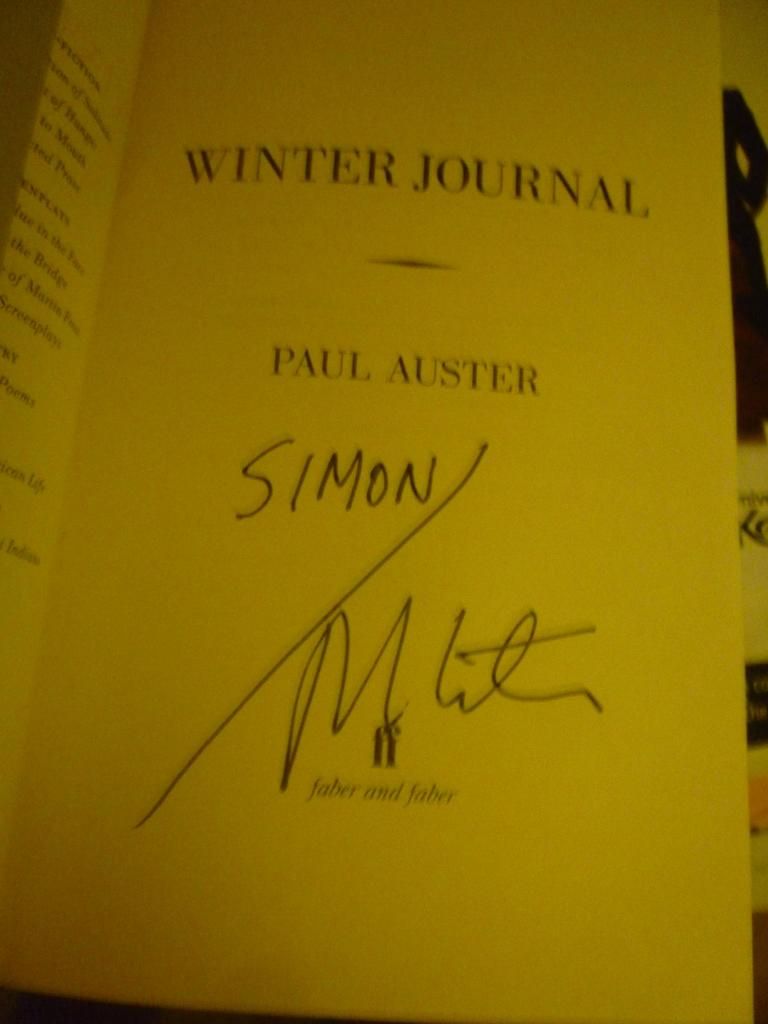
I got this signed after a talk Paul Auster gave in London. By all accounts, this book is meant to be very bad (the reviews describe it as rotten) and I don't care for much of his recent output. He seems to be taking his navel-gazing to nigh unimaginable levlels. Nonetheless, when he signed this for me, I went dumb and stayed mute. I didn't gush as to how much some of his books have meant to me. Still, I'm keeping this as a valuable memento.


Joseph Conrad is buried in Canterbury of all places. I searched the cemetery online and, as it happens, it is literally right next to my university. So, armed with a camera, I located it and... here it is. A real master.

Saturday, 29 December 2012

400th post

This is post no. 400. I've come a long way.

Admittedly, an awful lot of the writing on this blog has been turgid. But I think that the satisfactory posts have made it worth keeping. At least this blog has tracked how my writing skills have been honed (simpler, more elegant and less convoluted) and how my argumentative skills have improved (a bit subtler, less razor-tongued ranting).

Stay tuned for the next 400.

Thursday, 27 December 2012

Utility

An entrepreneurial producer of suction, who is a Tory, publicly stated something along the lines of "Why are we funding English courses? Why does anyone need to study French lesbian vampire poetry?"

Let's play this guy's game for a while. Let's be childish. What is more important? Suction or language? Having your carpet cleaned by a new hoover? Or having people study the nuances of language, so as to improve political discourse? And any other kind of discourse?

This latest Tory government brand themselves as a useful government. Their perspective on education repels me, to put it mildly. Courses on the Humanities are looked at with an evil eye (or, at the very least, taken with a pinch of salt). University isn't there to provide a grounding in epistemology and knowledge. They're there for business courses and to churn out employable people, who will help our frail economy. How? By playing a vital role in the private sector.

The fact that, somehow, the population of the country is going to get the economy out of its slump in private business is laughable. But for these guys, the Keynesian model (which has been tried and tested - successfully!) is laughable. Somehow, we are going to get ourselves out of our misery with the help of those committed, responsible folks in the private sector! No, we cannot boost the economy ourselves by investing in growth (that will increase our deficit!). And how can we pave the way to all this? Get people graduated in business! Not only that, we have to privatise education to ensure that only those guys high, high, high up in the top help us out!

That is all education means to these people. A means to an end. They don't realise that their choices are not only useless but harmful. They're making a pig-sty of the economy and disparities in wealth are getting wider and wider and wider.

To get society in the right track, you have to open people's eyes. Whilst I am a sceptic of universities (I am, and always will be, an autodidact), I think that they enlighten the lives of millions. I think that academic rigour, intellectual curiosity, defiance and creativity are indispensable assets. Business is fine, but that is not going to change the world. (I say this without being snobbish or high-minded.) ICT (which is funded a lot) will lead nowhere. English people are hopeless at languages (yet the government believes that if we speak more languages that will help international relations!), yet those courses they are getting cut right-left-and-centre. Perhaps even more depressingly, science is not seen as an interesting subject that can enhance understanding, it just provides chemists, doctors and physiotherapists. The biggest irony about people who claim to be efficient and useful is that they turn out to be inefficient, useless and, in the larger scheme of things, pernicious.

Monday, 24 December 2012

Writers and the world

Taking into account exclusive factors (i.e. literary aspects which aren't part of the text), I think that you could divide writers into two camps: those who are 'visible' and those who are 'invisible.'

There has been an awful lot of self-promotion from writers. A lot of the time this can cloud the talent (or lack thereof) they may have.

Ernest Hemingway, for example, publicised himself as a gruff, macho guy. Yet his writing style is dull, spare and nothing to write home about. His themes are totally uninteresting. The reputation he managed to solidify, in my view, is due to his promotional stratagems, rather than the literary value of his novels.

The beatnik crowd cashed in on their chicness to sell millions of books. Jack Keroac's On the Road drew attention to the fact that it was written in a two-week frisson of creativity, preceded by seven years of non-stop travelling. It has consolidated itself as a modern classic, the only irony being that it is completely unremarkable. Similarly, Charles Bukowski publicised himself as a counterculture 'outsider,' who drank and fucked all day. His novels do, indeed, describe him drinking and fucking all day, but little more than that.

The 'invisibility' of writers used to be an integral part of an author's oeuvre. When Thomas Pynchon published V., a journalist tracked down his house for an interview. Pynchon jumped out of a window of the second floor, eloped and was never seen, nor heard of, again.There have been a number of novels bearing his name, but they appear very sporadically. They are very dense, suffused with allusions and bizarre imagery. They contain so much that many readers have felt tempted to read them as a kind of self-mythologisatising. People think that, in a Pynchon novel, lies the Pynchon persona.

Sadly, the literary 'recluse' has ceased to exist. Now, if you want to get published, you have to promote and promote and promote. If you are the shy type, like I am, getting your stuff out there is very difficult indeed. You have to go out to readings, soirees, make acquaintances with publishers and be a visible face.

Yet, being a 'visible face,' you are still visible only to a select few - the literati, book publishers and people who love to read (sorry to bitch, but they are in short supply.) In the 1960s, 70s and 80s, writers constantly appeared in prime-time TV chat shows. People cared what they had to say about the state of culture, politics and the arts. Even if this overshadowed their books (which is much, much important), these still sold in higher numbers.

All this aside, this is still bullshit. With all this, it is always difficult to gauge real literary value. Hemingway has been consecrated as a master, but his books really have little value. Often, it's those who cash in trends, or who are simply more 'visible,' who make their name.

Friday, 7 December 2012

My favourite films of the year, '12

Here are my favourite films of the year. I also made a list of three films last year. (These were Midnight in Paris, Cave of Forgotten Dreams and The Tree of Life.) I've been following new releases quite closely now after I subscribed to Sight and Sound.

Films that narrowly missed this list were Tabu by Miguel Gomes, Amour by Michael Haneke and Cosmopolis by David Cronenberg.

The Master, dir. by Paul Thomas Anderson


I remember walking through a street in Manchester with my dad. There was a Scientology centre nearby, with a steward standing by the foyer. I loudly heckled something like (paraphrasing) "Look at that phony pseudo-mystical centre of brainwashing cunts!" This alarmed my dad who, fearing that the steward may have heard my loud diatribe, cautiously went "Shhhh!"

And this film, though it does not state so directly, follows what happens when you find yourself absorbed into that strange sect. The indoctrination therapies, the obnoxious bullying and the mandatory espousal of hocus-pocus quasi-mystical nonsense. It's little wonder that my dad was weary that the steward may have overheard my rant because, once these sly crooks set their eye on you, you're in for a whirlwind.

The film is even more heavy going, as the lead protagonist (not the master, incidentally, a disciple) is vulnerable, aggressive (The Master repeatedly calls him an 'animal') and simple-minded. He is the perfect prey for this opportunist's scheme.

The films becomes more wrenching as it progresses. We get therapy after therapy after therapy, with the disciple gasping for air. The Master, meanwhile, is constantly tested about the value of his endeavour by sceptics. He has no answers because, as a quack, he is only capable of producing vacous empty-headed babble short on either scientific or philosophical rigour. One of the many discomforting things about the film is that you somehow sympathise for him at times, no matter how facile or bullying he gets.

Finally, I'll mention that the misce-en-scene is fab - it really feels like 40s/50s America (and, later, UK). It is beautifully shot. And the performances (especially Hoffman's) are overwhelmingly good.

Into the Abyss, dir. by Werner Herzog

 Like the list I made last year, I've chosen another Herzog film. I think he's been on really good form of late.

The documentary deals with a devastating murder committed by a couple of ruffians in Texas, U.S.A. One of the criminals is ten days ahead of his sentence, looks remarkably calm, is unrepentant and denies the charges. The other convict, who genuinely exhibits feelings of guilt and remorse, gets a life sentence.

The film mainly consists of a series of interviews Herzog made with the convicts, family members, friends and witnesses. Herzog has been charged with exploiting his subjects in the past and here there are several scenes where the interviewees break out in tears.

Several ethical questions are obviously raised. How can the death penalty continue to be practiced? Are the criminals simply a result of their surroundings, having received little in the way of education? Herzog in the past has dealt with ethnographic and anthropological questions. Yet there's little sense of the interviewees being tools for a social case study. They are, on the main, seen as people who have undergone searing traumas. Herzog also completely avoids the political corruption in Texas (George W. Bush, as governor, signed off slip after slip of death penalties yet he does not figure at all in this film). What I mainly got from this film was a highly moving, emotional account of a human drama.

Nostalgia for the Light, dir. by Patricio Guzmán

Another documentary!

Guzmán apparently had trouble financing this when he pitched the idea. Astronomy, the Pinochet atrocities, the Atacama desert, Chilean history. How does it fit? As it turns out, there is no discrepancy with any of these things in the film.

There is an astronomy base in the Atacama desert, where astronomers observe the stars and record data. As this takes place, family of political prisoners whom Pinochet murdered, scour the arid surface for the remains of their relatives.

Time is a recurrent subject talked about, particularly from the scientists. The present, so we are told, is ever-elusive, as it can only be evoked through reflection. In addition to that, our bodies are made up of a great deal of calcium, which came from the stars. The astronomers are clearly searching for philosophical questions as well, something which is by no means exclusive from science. Archaeologists, meanwhile, are followed excavating relics of indigenous civilisations. The astronomers are on the look-out for figments of vast cosmological explosions that occurred billions of years ago. The archaelogists modestly admit their relics date from a few hundred years. (Interestingly, when I went to the Atacama Desert I was told by a tour guide that the Atacaman aborigines believed that the Spanish colonisers, and by extension the rest of the world, were invaders from space!)

And, perhaps more pertinently, the victims, instead of looking at the stars in awe, lower their heads to the ground in the hope they may find a bone or two of their kin.